Archive

Blog posts

One of the ways in which mothering has been directly, specifically useful for my writing is that I got to do a lot of reading aloud. I practiced first as a kid, on my younger sister. Later it was something that I loved about having children of my own.

So I’m honored that David Naimon asked me to talk about Le Guin, writing, and motherhood for this great podcast series, and I’m also really, really pleased that he asked me to read bits of my own and Ursula’s work. I enjoyed doing “The Fisherwoman’s Daughter,” including the great passages by Virginia Woolf about the writer “fishing the mind’s lake.” [56:30] And I loved talking [1:12:30] about the part of “The Shobies’ Story” that is about family, and getting lost, and how telling stories can help lost people find the way.

Listen here: https://tinhouse.com/podcast/crafting-with-ursula-julie-phillips-on-the-writing-mother/

Then listen to all the other episodes. Each one is a gem.

Author photo by Chris van Houts


“There’s a saying that there are only two stories: a person goes on a journey and a stranger comes to town. I knew my story: I was the stranger who came to town. But when my children came, I was no longer a stranger, or even at the center of my own story. In this way motherhood, which gave me myself, seemed paradoxically to take away my understanding of myself. I’d become something unknown to me.”

Leeuwarden City of Literature kindly invited me to write a short essay for their project Uitgesteld geluk (‘Happiness Delayed’). My contribution, on self and motherhood, will be read aloud by Marjolein Ley in Noardburgum, Friesland, on Thursday, Aug 11, in a beautiful Dutch version by Elske Schotanus. Afterward it will be published on their website in EN/NL/FR. Thank you to patient and sharp-eyed editor Tryntsje van der Steege, and to Elske for her translations into Dutch and Frisian.

Details here: https://www.leeuwardencityofliterature.nl/en/uitgesteld-geluk/julie-phillips/


I finally got to see the amazing Alice Neel show, in San Francisco, with my mother, Kit Phillips, who should have been in the picture with me but was taking it instead.

I have two in-person readings coming up. On Tuesday, May 31, at 6pm I’ll be at Elliott Bay Books in Seattle. On Wednesday, June 1, at 7pm I’ll be at Powell’s Cedar Hills in Portland. I hope to see you there! 

I’m working on a reading in Amsterdam in the first week of July. I’ll keep you posted.


A Room of One’s Own Books in Madison, WI, will host my online book launch on April 27, 6pm US Central Time, in conversation with Chris Kraus, author of the brilliant After Kathy Acker. We’re going to talk about motherhood, not-motherhood, artistic lives, and the art of biography. It’s 1 in the morning Amsterdam time, but don’t worry, it will be available online afterward.


I’m also working on in-person readings in Seattle and Portland in May, and in Amsterdam this summer. I’ll keep you posted.

As soon as The Baby on the Fire Escape comes out, I plan to start working on the biography of Ursula K. Le Guin. After talking to several wonderful editors I recently found homes for that book at Doubleday (US) and Virago (UK). I’m excited to be working with Thomas Gebremedhin and Rose Tomaszewska respectively. Virago made this great cover mockup for me to dream about while I’m writing.

Here’s the official news from The Bookseller (UK): https://www.thebookseller.com/rights/virago-snaps-up-first-and-only-authorised-biography-of-ursula-le-guin

And from the (Portland) Oregonian: https://www.oregonlive.com/books/2022/03/ursula-k-le-guins-biography-gets-a-publisher-and-a-release-date.html

Though I’m a notorious deadline blower I did promise to deliver a manuscript in 2025 for publication in 2026. Fingers crossed.


An insightful, provocative, and witty exploration of the relationship between motherhood and art—for anyone who is a mother, wants to be, or has ever had one.

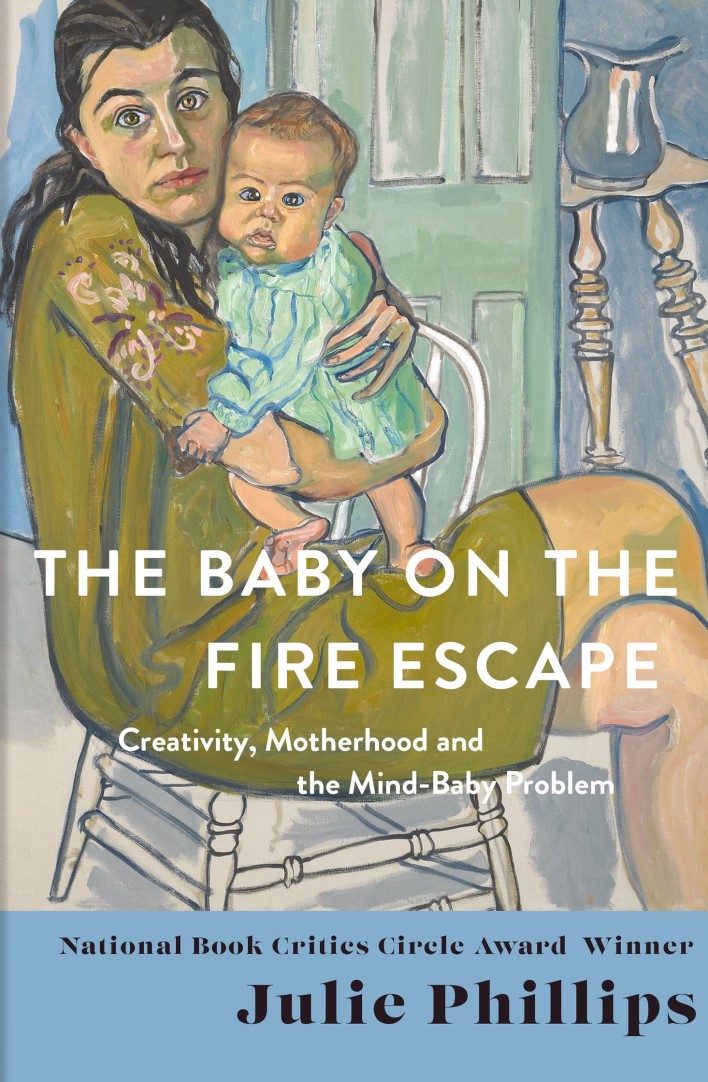
In my second book, The Baby on the Fire Escape, I explore the problems of creativity and motherhood, asking the questions, “What does a great artist who is also a mother look like? What does it mean to write, not in ‘a room of one’s own,’ but in a shared, domestic space?”

My original plan was to research biographical essays about some women I was interested in: Neel, Le Guin, Doris Lessing, Audre Lorde, Angela Carter, and others. They had motherhood in common, so I drafted a proposal saying I was going to explore the unmapped spaces in creative women’s lives. I assumed I would map as I went along.

Then I went out into those uncharted lands and got lost. I knew how to make a story about a creative life, but not a maternal one. Mothers’ experience started seeming not only unmapped but unthinkable.

The women I wrote about dealt with mothering in very different ways. Susan Sontag became a mother at nineteen, Angela Carter at forty-three. Alice Walker had one child, Diane di Prima five. They worked in the attic, in the car, in the bedroom, on the bed, at a desk with a baby carrier beside them. They loved mothering, struggled with it, redefined it to fit their lives. What they had in common was their fierce desire to find the time and self they needed to do their work.

I finally concluded that creative motherhood is about keeping the baby on the fire escape: it’s about maintaining a constantly renegotiated, provisional, day-to-day work-life balance. It’s about boundaries, and not giving too much of yourself away. And ultimately it’s a hero’s journey, in the fairy-tale sense: a tale of becoming, an adventure in the woods, the ones you have to go into when you lose yourself, whether as a mother or an artist, the place where the chronic, day-to-day time of care work becomes the narrative time of choice and change.

The Baby on the Fire Escape will be published by W.W. Norton, April 26, 2022 (US) and June or July (UK). The beautiful cover design is by Sarahmay Wilkinson, and the painting is Mother and Child (Nancy and Olivia), 1967, by Alice Neel.

This week I talked about Ursula K. Le Guin with host Trevor Chappell on Australia’s ABC radio. It was the late-night program, so I was grateful to be able to do it from a different time zone. I talked a bit about Ursula’s visit to Melbourne in 1975, when she was a guest of honor at WorldCon and taught a writing workshop that turned out to be hugely influential.

https://www.abc.net.au/radio/programs/overnights/profiling-the-life-of-poet,-essayist,-and-fantasy-and-science-fi/12617876

You can also watch the GoH speech Ursula gave in Melbourne, which is definitely worth your time. https://www.youtube.com/watch?v=Deuas-AuzbU


In recent weeks I’ve seen a discussion taking place around the names of literary awards, with many arguing that awards should not be named after people. One of those awards is the Tiptree.

I haven’t wanted to say much about this, mainly because I’m in the middle of revisions for the book that ate my life and my last two brain cells can barely get together to tie my shoelaces. But I’ve been tagged a few times on social media and I feel like I owe you a response.

A number of people are reading the manner of Alli and Ting’s Sheldon’s death as an instance of caregiver murder, in which a person with a disability is killed by a person responsible for caring for them. There is a pattern of murders like this being downplayed or dismissed as “understandable” because the caregiver “must have been under such strain.” This is extremely upsetting and hurtful to people living with disabilities. You can read more about this here and here. (Content warnings: suicide; Americans’ appalling lack of access to heath care.)

Mostly I’ve been asked for factual answers: Did it happen? Did it not happen? It may be that a name that calls up painful associations should be changed in any case. But I believe it matters to talk about what we know and don’t know, and here are some thoughts about Ting’s and Alli’s choices.

It’s evident that the narrative of caregiver murder plays a role in how the Sheldons’ death has been discussed. Accounts of their death often exaggerate Ting’s disability. When I first started researching Alli’s life, the entry in the Encyclopedia of Science Fiction said that Ting had Alzheimer’s Disease. Last week, before I went in and fixed it,* Wikipedia said that Ting was ”a nearly blind invalid incapable of caring for himself.” Neither is true. But there’s a tendency to alter the story—originally to try to excuse Alli’s actions—by portraying Ting as severely disabled and Alli as his long-term carer.

Yes, I’m sure the Sheldons had a suicide pact. No, I can’t say there was nothing dark there, that she didn’t coerce him into it. I can’t give Ting’s side of the story. But to picture their relationship as one of his dependence and her betrayal of his trust is an oversimplification of a complicated situation that maybe I can say more about.

In the 1970s, Alli Sheldon started to develop severe depression, which made her reliant on Ting’s emotional and physical care. She began abusing prescription drugs, and Ting did not act to stop her.

In the subsequent years, until her death in 1987, Alli often contemplated suicide but refused to kill herself while Ting was still alive. There were times when she talked about wishing to take him with her. There were times when she was terrified of his death. I see faint clues that she resented her own dependence on Ting, and that her own dependence may have pushed her toward a suicide pact. But I also see her warning herself not to end their lives before the agreed moment. Jeff Smith told me Ting, who was smart about people, may have consented to a suicide pact to make Alli promise to stay alive: yes, but it’s not time yet; later, not now.

When Alli first started talking about suicide, Ting was in good mental and physical health except that he suffered from progressive blindness, which was diagnosed in about 1976. By 1977 he had lost much of the sight in his right eye, but he could care for himself and Alli until (as far as I can tell) the mid-1980s, when he lost the ability to drive and read. I know that at the end of his life he was no longer able to take care of Alli, and that was apparently a blow to him, and I think to her too. Even then he was still active, seeing friends, doing the grocery shopping, by no means helpless or bedridden.

Unfortunately I can’t restore to Ting the subjectivity he deserves. For some versions of events I only have one source, and without confirmation I don’t like to rely completely on that information. By the time of his death Ting’s health was failing overall, which suggests a narrative of assisted suicide. I’m not sure the facts fit that interpretation, either, but I don’t want to deny Ting the possibility of agency and choice.

What I do see is that the Sheldons’ relationship was very close in ways that were not entirely healthy, and within that mutual dependence the idea of suicide evolved over a long time, between two people of whom one, Ting, did not leave a statement of consent. This is a place of shadows, and I can understand that some experience it as a place of hurt and anger. Where I don’t have answers, though, I resist imposing a false narrative of absolutes, either to excuse Alli or to condemn her.

“Murder” is a heavy charge to put on someone without proof. I can’t accept it.

I couldn’t have written the book I wrote without being open to contradiction. I’m troubled by some aspects of Alli’s death, and I’d like to acknowledge those who are distressed and angry. I also love her for her life, her writing, her struggle to exist and speak honestly in a hostile world. I’d like to acknowledge those who value her insight, courage, ingenuity, and integrity. If that’s a contradiction, I hope you can let it stand.

Concerning the name of the award, I’d like to leave that discussion to others. For myself, I can say that I first encountered Alice Sheldon through the name attached to the award, and that if the award hadn’t been called the Tiptree I might never have written the biography. But I have great faith in the wisdom of the Motherboard, and also I have a book to finish. The rest I leave to you, the community, hoping for a productive dialogue and trusting in your good judgment.


*Other than this, none of what’s on the James Tiptree, Jr., Wikipedia page is by me. It’s not my baby.

unnamed.png

Writer-director Maureen Huskey’s play based on the life and work of James Tiptree Jr. premieres in Los Angeles, October 27, 2018. “Dodging in and out of reality, the play investigates gender, longing and creativity as self-exploration through one of the science fiction world’s greatest literary tricksters.”

This play has been in the works for some time, and I’m excited that it’s finally making it to the stage. More info below and at www.maureenhuskey.org.


LOS ANGELES, Calif. (April 19, 2018) — The Woman Who Went to Space as a Man – Part fact, part fever dream, and part musical, this captivating new work opens with Alice B. Sheldon – better known to sci-fi aficionados as author James Tiptree, Jr. – contemplating suicide. Dodging in and out of reality, the play, with a bold musical score from award-winning world music artist Yuval Ron, investigates gender, longing and creativity as self-exploration through one of Science Fiction world’s greatest literary tricksters. Sheldon was most notable for breaking down the barriers between writing perceived as inherently ‘male’ or ‘female’. It was not publicly known until 1977 that Tiptree was, in fact, a woman. Inspired by the biography ‘James Tiptree, Jr.: The Double Life of Alice B. Sheldon’ by Julie Phillips along with ‘With Delicate Mad Hands’ by James Tiptree, Jr., Maureen Huskey wrote and directs the first production of The Woman Who Went to Space as a Man, opening October 27 and running through November 17, at Son of Semele Theater in Los Angeles.


Alice B. Sheldon started writing science fiction under the male pen name of James Tiptree, Jr. as a last grasp for life at the age of 50. Without expecting any success, Sheldon as Tiptree ended up taking the science fiction world by storm writing the most provocative and socially relevant stories to this day. Influential science fiction writers such as Phillip K. Dick wanted to collaborate with him; Ursula Le Guin and Joanna Russ put him on a pedestal and in 2012 Tiptree was inducted into the Science Fiction Hall of Fame. For years, no one knew Tiptree’s true identity. Ironically it was the remarkable life Sheldon led as a woman that made her so believable as a man. She was an officer in the Army, worked for the CIA, the pentagon and traveled the world. 


The Woman Who Went to Space as a Man takes imaginary license whereby Sheldon is visited by an unexpected stranger — an extraterrestrial “star caller” from one of Tiptree’s stories — who leads her on an episodic, emotional journey through the shadows of her past where, despite her life’s accomplishments, buried pain and unmet desires reside. She encounters her younger selves, her repressed lesbian love, a domineering mother, and the incarnation of her male alter-ego: James Tiptree, Jr. The play locates unexpected links between gender orientation, creative expression and mental health, and shows how science fiction became the answer to Sheldon’s struggles as a woman. 


The Woman Who Went to Space as a Man has universal and topical resonance as it deals directly with the repression of women, of gender/sexual orientation, depression and the search for hope. It also brings science fiction — a form that was long marginalized — to the center stage and shows how Alice B. Sheldon used science fiction to address issues that plague humanity such as genocide, ecocide and racism. The play experiments with form, episodic storytelling, shifting time and vacillating between inner and outer realities. It is interwoven with one of Tiptree’s short stories to frame the telling of Sheldon’s life.


“
I have always been drawn to the lives of female artists; especially those who committed suicide. While their work may be celebrated, often their lives and personal triumphs are not. My intention is to unapologetically shed light on one of these overlooked lives: a true story about a woman who pretended to be a man,” explains Huskey.


Tiptree earned the reputation of being a male author who understood women and often addressed gender issues – on Earth and in worlds beyond. Having spent her entire life in male-dominated arenas – the Army, the C.I.A., academia, and finally science fiction writing – Sheldon had become a person who could say all of the things she felt she couldn’t as a woman. Once outed, Sheldon didn’t feel a sense a liberation, her confidence rattled with the transition from a perceived male writer to a female one and she faded from the science-fiction scene leaving her legacy behind.

On June 13 in Portland, OR, Literary Arts brought a terrific lineup of writers together to speak about Ursula Le Guin’s life and work. The evening included family photos, clips from Arwen Curry’s documentary Worlds of Ursula K. Le Guin, and a dragon at the end. The speakers remembered Ursula the teacher, builder of bridges, dreamer of change, writer of wildly funny e-mails, and fierce, kind friend.

We writers were all nervous at having to speak in front of over 2000 people, but the event came off beautifully: the talks were terrific, the memories bittersweet. My only regrets were that it didn’t go on longer—say, a week—and that we were onstage instead of Ursula herself. Hearing her in the clips makes me miss her profoundly, her wonderful, musical voice most of all.

You can watch the whole tribute at www.literary-arts-tribute.org/. My bits are at 30:00 (on tape) and 1.22:20 (my talk).

Thank you, Literary Arts, and thank you, Ursula.

Photos: Literary Arts

Image may contain: 3 people, people standing and outdoor


Image may contain: night, car and outdoor

Charles Vess with a dragon from his forthcoming illustrated Earthsea:

Image may contain: 3 people, people smiling, people standing

No automatic alt text available.