Archive

Blog posts

I’m looking forward to Emily St. John Mandel’s event at the American Book Center in Amsterdam. She’ll read from Station Eleven–the book I saw in every airport in America this summer–and I’ll do a Q&A with her afterward. The reading is Friday, August 28, at 18:30; more info at abc.nl/events.


Station Eleven

Alli 1945 Wiesbaden
“I think you ‘stand’ being a woman exactly as I stand being me, what is oneself that one ‘stands’ but a peculiar cloudy fiery lens, an invisible intersection of fluxes of experience, a nothing that is everything and everywhere?”
–James Tiptree, Jr., to Joanna Russ, 1975

Alice Sheldon would have been 100 years old today.

In honor of Alice Sheldon’s 100th birthday, Australia’s Twelfth Planet Press is publishing a selection of “letters to Tiptree” by an impressive list of science fiction and fantasy writers, editors, critics, and fans. Nicola Griffith’s letter also appeared last month in the Los Angeles Review of Books. Brit Mandelo’s letter has been excerpted at Tor.com. More on Letters to Tiptree, edited by Alisa Krasnostein and Alexandra Pierce, at the Twelfth Planet website.


“I dreamt I was falling in love with Alice Sheldon.
She didn’t want me. So I tried getting myself killed
on three continents. Years passed. Finally, when I
was really old, she appeared on the other end of the
promenade in New York and with signals (like the
ones they use on aircraft carriers to help the pilots
land) she told me she’d always loved me.”
–Roberto Bolaño, Tres

Along with Philip K. Dick, James Tiptree, Jr., was Bolaño’s favorite science fiction writer.

Neel, Geoffrey Hendricks and Brian, 1978For my book on mothers & writers I’ve been reading and thinking about the painter Alice Neel (1900-1984). Neel was known for her portraits; she saw herself as a political painter, chronicling her time “using the people as evidence.” She was especially sympathetic to people whose individual humanity has not always been acknowledged in paint: the poor, people of color, gay and trans people. She also loved painting the signs of sexual liberation—maybe because, after years of bohemian living and unconventional mothering, she had a lot of experience in not caring what anyone thought.

To celebrate the legalization of gay marriage in the United States I thought I’d post her 1978 portrait of a couple, the artists Geoffrey Hendricks and Brian Buczak. Neel posed them at her kitchen table, Hendricks later recalled, and “brought out the bowl of bananas and avocados with a little twinkle in her eye.”

I posted this on Facebook on January 17, and because of the protest surrounding the PEN American Center’s “courage” award to Charlie Hebdo, I’m reposting it here. I understand the concerns of the letter-signers, but this is how it looks to me from a Dutch perspective. Bearing in mind that we on the left all want to get to the same place and are just arguing about the means—here goes.

I agree that other people and even other cultures—especially poorly understooDorinde Republique 12 Jand, marginalized cultures—are entitled to our respect and consideration. But I don’t think that protection should extend to fundamentalism, which seeks power by courting offense and trying to shut down the dialogue that’s actually taking place.

There’s a conversation about values that goes on in Western Europe all the time, one that Americans don’t usually hear. European Muslims, because they’re European, are entitled to make demands on public life. And then Europeans as a group get to hash out whether or not those demands are reasonable. What’s offensive to whom, and what will we do about it?

Should a public mural showing a naked woman be taken down? (Nudity is a surprisingly important Dutch cultural value: Taboo-breaking! Liberation! It does less for me than for some, but there you go.) Should some schools offer sex-segregated swimming lessons, because some Muslims don’t think 8-year-old boys and girls should see each other in bathing suits? (Swimming lessons are part of a Dutch elementary school education.) Can Muslim public schools have their own curriculum? (Yes, Muslim public schools. All schools are public here, even the ones with a religious orientation. Private, fee-paying schools hardly exist.) How can we address prejudice against Dutch people of foreign origin? The dominant group definitely gets away with more. Job discrimination against people of foreign ancestry is persistent. But change happens and understandings are reached. In other words, offending and being offended aren’t set in stone; they’re flexible and negotiable.

Understanding becomes more difficult when the cultural position is “My neighbor is gay, and as a good Muslim I’m going to throw a brick through his window.” So homosexuality is drawn into the conversation. In Amsterdam, to increase acceptance, teams go around to all the public high schools to explain to 9th graders what homosexuality is and teach them that it’s normal. (Nice, no?) Last year, for the first time, a Moroccan-Dutch group felt safe enough to participate in Gay Pride.

Antisemitism is the most intractable problem of all: since the murders at the Jewish Museum in Brussels last fall, there’s been a permanent police guard post in front of the Anne Frank House.

But for the most part there’s a healthy discussion—up to the point where fundamentalism gets involved. Fundamentalist values aren’t flexible; they’re both arbitrary and absolute. Fundamentalists take offense because being offended is what fundamentalism does, how it exercises power over the conversation. Fundamentalists can be provoked by drawings of Mohammed, education for girls, atheism, extramarital sex, contraception, Harry Potter, and/or the existence of the clitoris. A blogger can get sentenced to 1,000 lashes for calling on fundamentalists to stop “claiming exclusive monopoly of the truth.” (Raif Badawi! Write a letter!) I offend all three monotheistic fundamentalisms just by existing as a woman and an unbeliever.

I see Charlie Hebdo as directing its satire, not against Islam, but against fundamentalism in any form, whether Islamic or Islamophobic, coming from Muslims or the Front National. It wants to set boundaries on our right to be offended. It wants to mock and expose these threats on both sides so the dialogue about values can continue.

Satire is a risky response to fundamentalism. It’s wild and not well controlled and there’s a risk it will hit the wrong targets.

But every fiber of my female, educated, unbelieving being longs to satirize like hell.

Photo Dorinde de Tempe, Paris, January 12.

I had Stephen Fry’s thoughts on Charlie Hebdo in mind when I wrote this. On the PEN question there have been excellent comments from Adam Gopnik in the New Yorker, Laura Miller in Salon, and Katha Pollitt in the Nation, among others.

Best of success to Patrick French, who was chosen by the estate of Doris Lessing to write her biography. From all the work I’ve done on her so far I think she’ll keep a biographer very good company. I’m looking forward to publishing my essay on her in The Baby on the Fire Escape; the story of Lessing’s motherhood is very different from the one you think you know.

Thief-of-timeI came late to the fantasy world of Terry Pratchett, and I might never have come there at all if hadn’t been for A.S. Byatt. In 2011 in Amsterdam I interviewed her for Trouw, and afterward we were talking about her book Ragnarok and science fiction when she asked me if I had read Pratchett. When I said no she looked so crestfallen that I hastily–and somewhat truthfully–added, “I’d like to, but he has so many books I don’t know where to start.”

At that point Dame Antonia was already on record as one of Pratchett’s most prominent literary fans. What she loved above all, she wrote in a Guardian review, were his powers of invention. “He gives you more information and more story than you need, just because he can… He is a master of complex jokes, good bad jokes, good dreadful jokes and a kind of insidious wisdom about human nature (and other forms of alien nature).” She later suggested a simple reading program for young people: distribute Pratchett books free to all British 12-year-olds.

She promised to write me with suggestions for my first Pratchett book, and a week later she sent me her guide to Discworld. I quote it here with permission:

There are the wizard stories, beginning with The Colour of Magic, and the Guards of Ankh-Morpork, beginning with Guards! Guards! and the ones about witches, beginning with Wyrd Sisters. And a few other strands. The novels get better as he goes on inventing, but you miss things if you begin at the end, as he develops both characters and stories. One good one is Small Gods (from St Augustine) … Another very good one is Thief of Time. There are some late Ankh-Morpork ones that are excellent – Going Postal, or The Truth – and probably do stand on their own, tho they gain from a knowledge of the world they are set in. And one of my favourites is Jingo but I don’t think it would work so well without either Guards! Guards! or Men at Arms as background. They read fast if you like them, but more than 50% of my friends don’t.

Challenged by that last sentence I went to the city library, borrowed Thief of Time, and became an instant and lasting addict. I followed her list and found her advice to be excellent. It’s true that the early books are not nearly as good as the later ones, but it’s a pleasure to watch the central characters grow and change, and to see Pratchett develop from a low-grade parodist to a stiletto-sharp social satirist.

To this list of starting places I would add Mort, in which one of Pratchett’s most lovable and enduring characters, Death himself, makes his debut. Going Postal, with its reformed con man hero Moist von Lipwig, is a clever and endearing piece of commentary on corporate culture, the Internet, and the power of the written word. Small Gods brilliantly explores of the logic of religious belief, while Thief of Time is just full of genius inventions, from bonsai mountains to the Procrastinators, spools that wind and unwind time. Part Hitchhiker’s Guide, part Three Men in a Boat, Pratchett’s comedy finds absurdity in the familiar while putting us on familiar terms with the absurd.

Every time I requested another Pratchett book from the library I thought (and occasionally said), “I’m reading this because A.S. Byatt said I should.” Armed with her approval I bought paperbacks with childish covers and enjoyed myself immensely.

At the end of her note to me, on the subject of writers who are mothers, Byatt added a P.S.: “Do you know the stories of G.E.M. Anscombe, the philosopher who edited Wittgenstein, who commuted from Oxford to Cambridge, changing at Bletchley as one did in those days, and left her baby on Bletchley station in a Moses basket?”

It seems to me that anyone who can truly appreciate that level of materno-philosophical absent-mindedness is doomed to be a Pratchett fan.

Unless Death relents and gives him back to us, there will be no new Pratchett books. But if you haven’t started reading him, now you know how and you know why: because A.S. Byatt says you should.

Sir Terry Pratchett died on March 12, 2015. I started an obituary for him, hunched over my laptop and a Cappuccino zum Mitnehmen in the middle of the Leipzig Book Fair. Then my editor at Trouw had to call my piece off because of a prominent Dutch demise. So I wrote this instead.

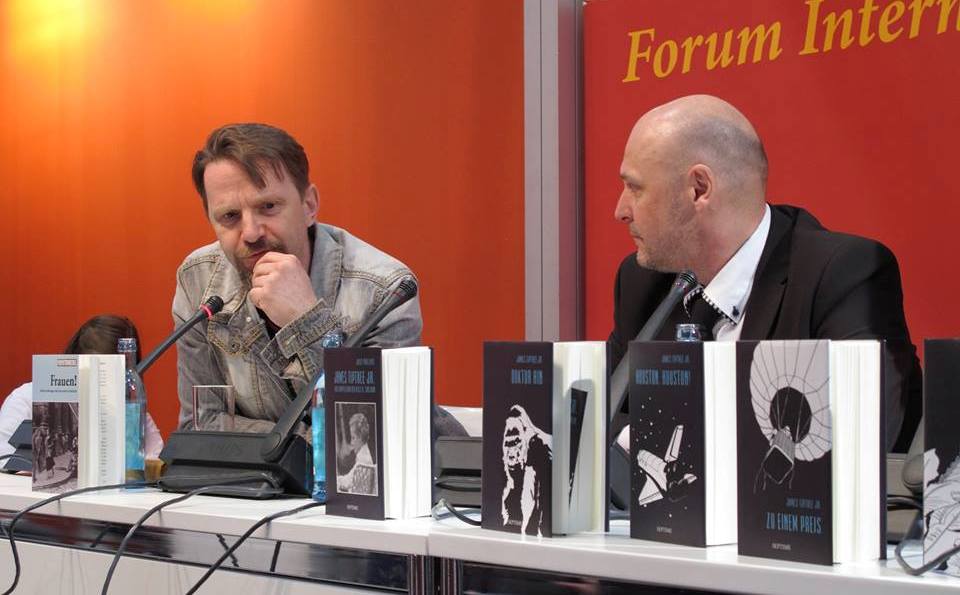
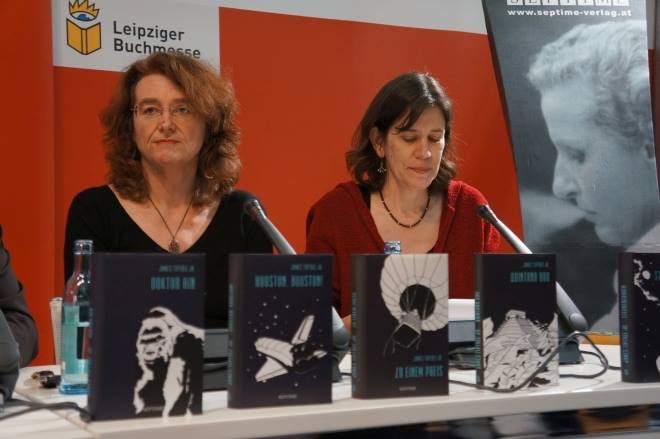
Here, belatedly, are a couple of photos from the talk in Leipzig on “100 Jahre James Tiptree Jr.,” the first event of the Alice Sheldon year. I shared a panel with three of the people involved in publishing the complete works of Alice Sheldon in German: writer and translator Frank Böhmert; translator Elvira Bittner, and publisher Jürgen Schütz of Septime Verlag.

panel Frank Juergen Golkonda crop

Frank (left) read from “Frauen, die man übersieht” and spoke about some of the problems of translating Tiptree. He observed that Alice Sheldon’s voice is very much her own–so much so that when he does an internet search for a phrase from a Tiptree story it generally leads him straight back to the text he’s translating.

Jürgen (right) talked about his project to publish the complete works of Tiptree in German, now nearly complete. The book covers are all his designs.

Elvira

Lovely Elli (left), stern Alli (right), and I pose with the series. I answered questions; Elvira translated my answers and read a section from the biography. The photos are from the guys at Golkonda Verlag in Berlin, who sat in the front row and laughed in all the right places. Thank you!

At the book fair I also got to catch up with Britta Böhler, top lawyer and half of the Amsterdam-based crime writing duo Britta Bolt, whose debut Lonely Graves has the best cover ever for its German translation.

Thanks to Esther, Jürgen, and everyone at Septime for another weekend of great company.

Radio producer Eric Molinsky interviewed me in New York in October for a half-hour podcast on James Tiptree, Jr. At the time I I thought I was brilliant. Listening to it now I think that must have been a jet-lag-induced illusion. But Eric did a terrific job.

It makes me wish there were recordings of Alli Sheldon reading from her own work. I have copies of some spoken journals that she taped, but as far as I know she never recorded herself reading.

http://www.imaginaryworldspodcast.org/the-mysterious-james-tiptree.html