Thief-of-timeI came late to the fantasy world of Terry Pratchett, and I might never have come there at all if hadn’t been for A.S. Byatt. In 2011 in Amsterdam I interviewed her for Trouw, and afterward we were talking about her book Ragnarok and science fiction when she asked me if I had read Pratchett. When I said no she looked so crestfallen that I hastily–and somewhat truthfully–added, “I’d like to, but he has so many books I don’t know where to start.”

At that point Dame Antonia was already on record as one of Pratchett’s most prominent literary fans. What she loved above all, she wrote in a Guardian review, were his powers of invention. “He gives you more information and more story than you need, just because he can… He is a master of complex jokes, good bad jokes, good dreadful jokes and a kind of insidious wisdom about human nature (and other forms of alien nature).” She later suggested a simple reading program for young people: distribute Pratchett books free to all British 12-year-olds.

She promised to write me with suggestions for my first Pratchett book, and a week later she sent me her guide to Discworld. I quote it here with permission:

There are the wizard stories, beginning with The Colour of Magic, and the Guards of Ankh-Morpork, beginning with Guards! Guards! and the ones about witches, beginning with Wyrd Sisters. And a few other strands. The novels get better as he goes on inventing, but you miss things if you begin at the end, as he develops both characters and stories. One good one is Small Gods (from St Augustine) … Another very good one is Thief of Time. There are some late Ankh-Morpork ones that are excellent – Going Postal, or The Truth – and probably do stand on their own, tho they gain from a knowledge of the world they are set in. And one of my favourites is Jingo but I don’t think it would work so well without either Guards! Guards! or Men at Arms as background. They read fast if you like them, but more than 50% of my friends don’t.

Challenged by that last sentence I went to the city library, borrowed Thief of Time, and became an instant and lasting addict. I followed her list and found her advice to be excellent. It’s true that the early books are not nearly as good as the later ones, but it’s a pleasure to watch the central characters grow and change, and to see Pratchett develop from a low-grade parodist to a stiletto-sharp social satirist.

To this list of starting places I would add Mort, in which one of Pratchett’s most lovable and enduring characters, Death himself, makes his debut. Going Postal, with its reformed con man hero Moist von Lipwig, is a clever and endearing piece of commentary on corporate culture, the Internet, and the power of the written word. Small Gods brilliantly explores of the logic of religious belief, while Thief of Time is just full of genius inventions, from bonsai mountains to the Procrastinators, spools that wind and unwind time. Part Hitchhiker’s Guide, part Three Men in a Boat, Pratchett’s comedy finds absurdity in the familiar while putting us on familiar terms with the absurd.

Every time I requested another Pratchett book from the library I thought (and occasionally said), “I’m reading this because A.S. Byatt said I should.” Armed with her approval I bought paperbacks with childish covers and enjoyed myself immensely.

At the end of her note to me, on the subject of writers who are mothers, Byatt added a P.S.: “Do you know the stories of G.E.M. Anscombe, the philosopher who edited Wittgenstein, who commuted from Oxford to Cambridge, changing at Bletchley as one did in those days, and left her baby on Bletchley station in a Moses basket?”

It seems to me that anyone who can truly appreciate that level of materno-philosophical absent-mindedness is doomed to be a Pratchett fan.

Unless Death relents and gives him back to us, there will be no new Pratchett books. But if you haven’t started reading him, now you know how and you know why: because A.S. Byatt says you should.

Sir Terry Pratchett died on March 12, 2015. I started an obituary for him, hunched over my laptop and a Cappuccino zum Mitnehmen in the middle of the Leipzig Book Fair. Then my editor at Trouw had to call my piece off because of a prominent Dutch demise. So I wrote this instead.
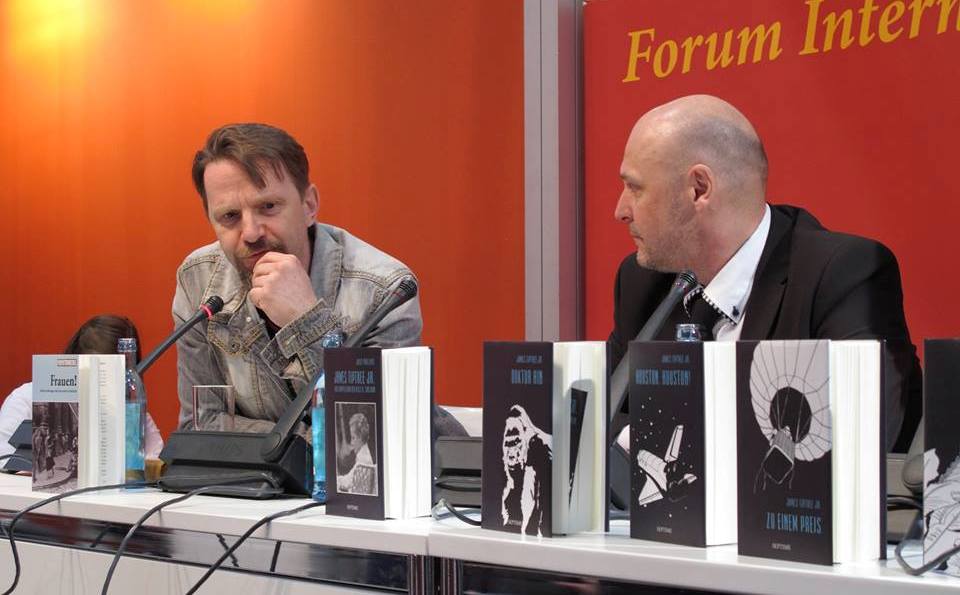
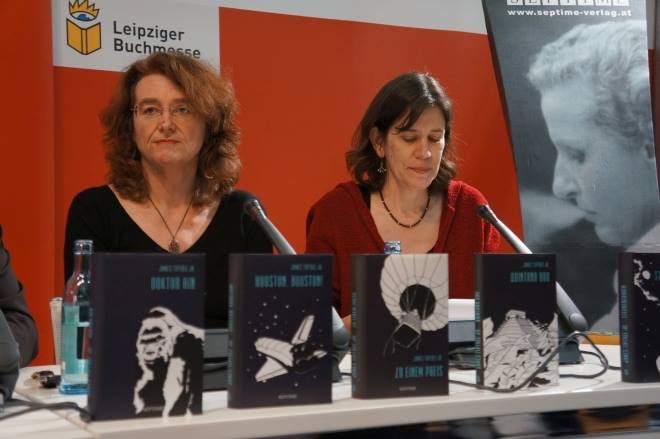
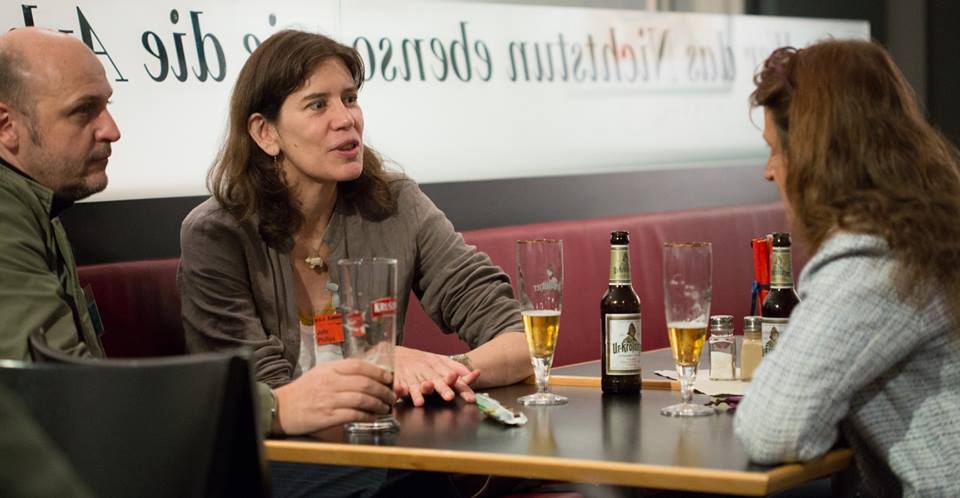
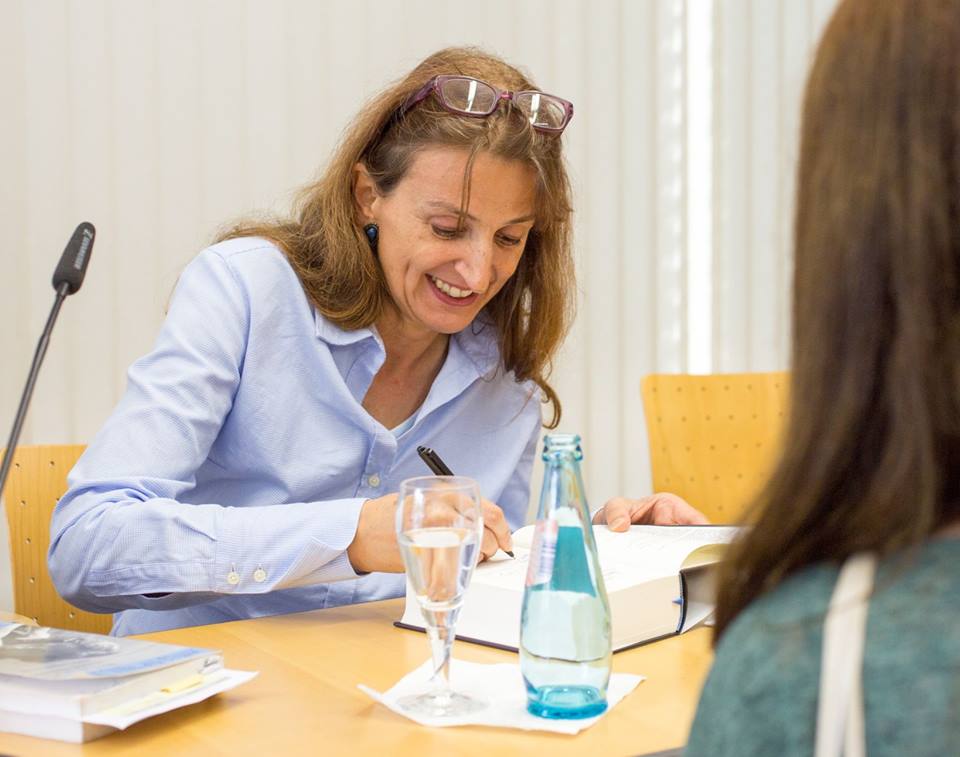
Here, belatedly, are a couple of photos from the talk in Leipzig on “100 Jahre James Tiptree Jr.,” the first event of the Alice Sheldon year. I shared a panel with three of the people involved in publishing the complete works of Alice Sheldon in German: writer and translator Frank Böhmert; translator Elvira Bittner, and publisher Jürgen Schütz of Septime Verlag.

panel Frank Juergen Golkonda crop

Frank (left) read from “Frauen, die man übersieht” and spoke about some of the problems of translating Tiptree. He observed that Alice Sheldon’s voice is very much her own–so much so that when he does an internet search for a phrase from a Tiptree story it generally leads him straight back to the text he’s translating.

Jürgen (right) talked about his project to publish the complete works of Tiptree in German, now nearly complete. The book covers are all his designs.

Elvira

Lovely Elli (left), stern Alli (right), and I pose with the series. I answered questions; Elvira translated my answers and read a section from the biography. The photos are from the guys at Golkonda Verlag in Berlin, who sat in the front row and laughed in all the right places. Thank you!

At the book fair I also got to catch up with Britta Böhler, top lawyer and half of the Amsterdam-based crime writing duo Britta Bolt, whose debut Lonely Graves has the best cover ever for its German translation.

Thanks to Esther, Jürgen, and everyone at Septime for another weekend of great company.

Radio producer Eric Molinsky interviewed me in New York in October for a half-hour podcast on James Tiptree, Jr. At the time I I thought I was brilliant. Listening to it now I think that must have been a jet-lag-induced illusion. But Eric did a terrific job.

It makes me wish there were recordings of Alli Sheldon reading from her own work. I have copies of some spoken journals that she taped, but as far as I know she never recorded herself reading.

http://www.imaginaryworldspodcast.org/the-mysterious-james-tiptree.html

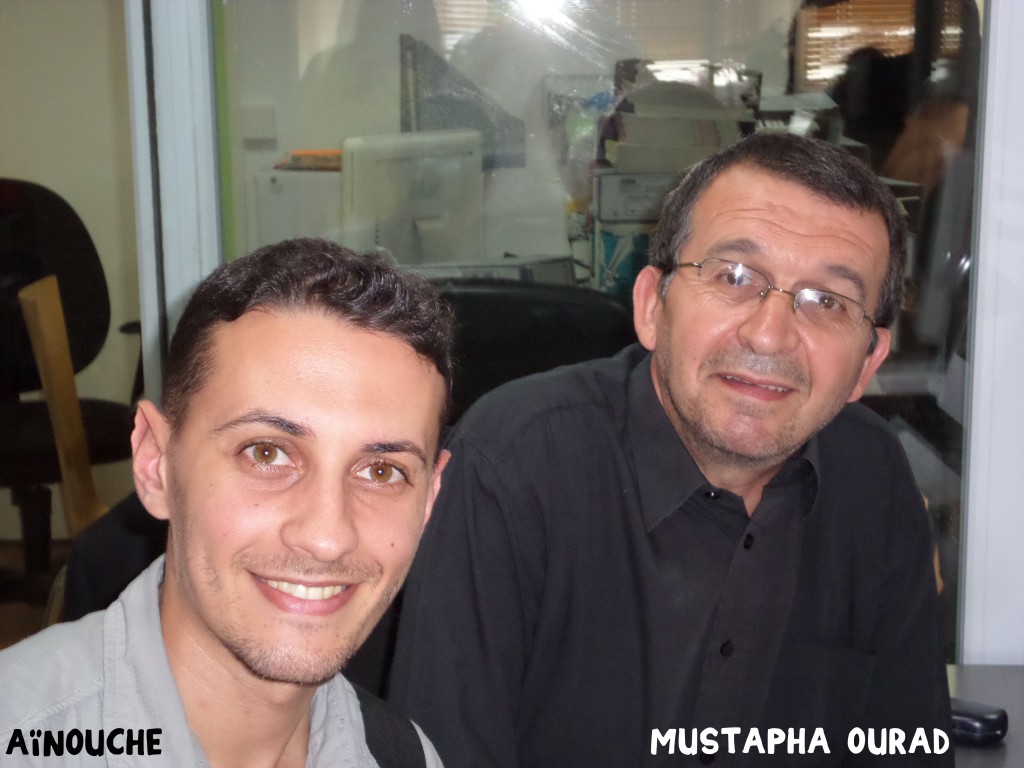
Because copy editors are independent-minded grammar nerds, and because I’ve been one, and because I haven’t seen this in English anywhere else, I put together what I could find about the copy editor at Charlie Hebdo, Mustapha Ourrad. He was 60 and had been at the paper since 1997. His friend Fabien Soyez says, “He was a leftist and worked for Charlie Hebdo because he believed in their ideal of freedom. He wasn’t the type to work for an employer who didn’t share his humanist values.”

Friends describe him as reserved, erudite, concerned, kind, and funny. Former colleague Christophe Baffier-Candès says he was “toujours pince-sans-rire, et adorable”—always tongue-in-cheek, and adorable.

As a copy editor he was patient and professional. Colleagues praise his “discernment and elegance in his work, his mastery and love of language.” He liked to talk about literature and loved to recite poetry from memory.

Another friend, Elsa Maudet, recalls, “He told me all about the Bateau-Lavoir and the artists who lived there, the banquet organized by Picasso. In the Place Marcel Aymé he stopped in front of the statue of The Man Who Walked Through Walls and retold the whole plot of the story. […] My mother said, ‘When you talked about him you always had stars in your eyes.’”

He had a “hard” childhood in Kabylia, a Berber region of Algeria, and came to France at age 20 in 1974. A hometown friend remembered him as a great reader and brilliant student whose nickname was “Mustapha Baudelaire.” He said of himself that he was not Algerian but Kabylian, not Muslim but a “Sufi atheist.”

He had another gig at a health magazine–the job that paid the bills, I imagine. He wasn’t usually at Charlie Hebdo on Wednesdays—he worked the paper’s Monday close—but was in the office to check a special issue.

He was separated from his wife and had two teenage children.

(Assembled from French, Algerian, and Italian websites and Elsa Maudet’s Twitter feed. The quote from Fabien Soyez is from the Dutch newspaper De Volkskrant, The translations are mine, with a little help from Google. The photo is from algerie-focus.com and shows Mustapha Ourrad, or Ourad, with Algerian cartoonist Ghilas Aïnouche at the office of Charlie Hebdo. Reposted from Facebook.)

Mustapha Ourad

I don’t usually write about politics, and I haven’t published much of anything lately because I’ve been working on my book. But I was struck by a gap between the American and European understanding of the Charlie Hebdo murders. I’m reposting this from my private Facebook page.

Is Charlie Hebdo racist?* Why has the European reaction been so strong? Here’s the thing: until the ‘60s, the church, Catholic and Protestant, had a strong repressive influence in Europe—much more so than in the US. The leftists of the May ’68 generation saw themselves as opposing church censorship. The European left still regards the right to question—and mock—religious authority as hard-fought and central to its identity.

At the same time the French in particular, and the Dutch, too, are deeply attached to the right to offend. As one writer put it, Charlie Hebdo represents “an anarchic populist form of obscenity that aims to cut down anything that would erect itself as venerable, sacred or powerful.” This tradition, as you might expect, regularly gives rise to conflict.

Islam especially divides the left. Either you say it’s racist to criticize Islam, so it should be given an exception, or you insist that Islam, like all other religions, is a legitimate target for satire. In general leftist Europeans, Muslim and non-Muslim, are much more involved than Americans with the whole question of free religious critique.

That freedom is one that has been directly threatened by fundamentalist violence ever since the fatwa on Salman Rushdie. In my view the ‪Je Suis Charlie demonstrations are a response to the threat of violence and also a rejection of attempts by the right to hijack the debate and use free religious critique to justify intolerance.

So while Americans might see Charlie Hebdo as a weird, marginal, probably racist by-product of freedom of speech, Europeans are more likely to see Charlie Hebdo, whether they approve of it or not, as being at the heart of an embattled territory.

*I was using the wrong term here. “Prejudiced” or “Islamophobic” would have been better. 

Practically everyone I know loves Cloud Atlas except me. David Mitchell’s 2004 novel is ambitious and clever, I can see that, combining six storylines, each written in a very different style, all loosely connected by a shared vision of human weakness and impending (self-)destruction. (Actually, “novel” hardly seems an adequate term for this kind of 500-page stem-winder. If a small novel is a “novella,” what is an overlong one? Novelissimo? Novepedia?) Switching modes from epistolary novel to thriller to dystopian fiction, Cloud Atlas foregrounds the art of storytelling while doing what science fiction does, and what most of us too seldom do as we’re carried along in the river of the present: ask where we’re going and how we got to where we are. By borrowing elements from genre it achieves that grand sweep from history to future that’s always exciting when you encounter it for the first time.

When you look at the parts separately, though, what do you have? A couple of highly ironic historical fictions, a second-rate thriller, one extended satiric interlude, and two sci-fi tales, all too long, all drenched in a sticky sauce of pastiche and imitation. The parts set in the future feel especially hollow: Mitchell lacks the inventiveness, the originality of vision, the moral urgency or wild-eyed paranoia that might make him a great writer of speculative fiction. As big and memorable as it is essentially gimmicky, Cloud Atlas is the “Bohemian Rhapsody” of postmodern literature.

Instead I admire a different Mitchell, the one who is so good at evoking real places and moments of everyday intimacy. His terrific gifts as a realist can best be seen in Black Swan Green, his short, sweet novel of English childhood in the 1980s, full of living, breathing characters, funny, moving, and believable human interactions, and moody, beautifully realized settings. As the hero journeys through the small dystopia that is the age 13, Mitchell gives each event its own tinge of magic.

Mitchell’s sixth novel, The Bone Clocks, is more like Cloud Atlas, another genre-blending, career-advancing doorstop of a book. But here Mitchell’s realist gifts are all seductively, brilliantly on display. It begins in the summer of 1984 in Thatcher’s England, when Holly Sykes, a 15-year-old with spiky hair and a thorny attitude, has a fight with her mother and leaves her home in Gravesend, east of London. On foot she follows the Thames toward its mouth at Sheerness, over flat, empty, sun-filled land, stitched with power lines and motorways, scarred with bunkers and gravel pits. The Thames, that slow river of the present, is “biro-blue; the sky’s the blue of snooker-chalk.” In Mitchell’s hands, a calm summer day on the edge of London, in a landscape where the place names that sound magical but turn out to be on the map—Allhallows, Saint Mary Hoo, the Isle of Grain—becomes a ravishing setting for the beginning of an adventure.

As in Cloud Atlas, Mitchell breaks his narrative into six sections, switching sharply from one perspective to another. This time the stories are more closely connected, though, both to each other and to our own time and place. After Holly, we step into the mind of a fatally self-involved Cambridge student, then jump to 2004 as seen through the eyes of Holly’s husband, a war reporter and devoted father. Then we move into the future with the former “Wild Child of British Letters,” a misbehaving middle-aged writer à la Martin Amis. This satiric interlude is followed by a long fantasy action sequence, culminating in a supernatural battle; and when Holly returns to tell the ending, she’s a grandmother and the year is 2043.

Some of the narrative and thematic strands that connect these stories have to do with time, rebirth, what of us survives after death. As a child, Holly is “cured” of hearing voices by one Dr. Marinus, who is later revealed to be a Horologist, a member of a small group of souls that are reincarnated, life after life, with all their memories intact. (He is, of course, the same Dr. Marinus who appears in The Thousand Autumns of Jacob de Zoet; several figures from Mitchell’s earlier novels are given new literary lives in The Bone Clocks.) Opposed to the Horologists are the Anchorites, who preserve eternal youth in their own bodies by drinking the souls of others. “Bone clock” is the Anchorites’ scornful word for a mortal body, doomed to tick away the hours from birth to death.

This reincarnation fantasy is also a commentary on one of Mitchell’s central themes, the art of fiction. It serves as a metaphor for what readers do as they move from story to story, in each one occupying another person’s body and mind. It’s also—especially since Mitchell has said his books should be read as a set of linked narratives—a way of continuing Mitchell’s ongoing interrogation of man’s fate. Within the narrow limits of human power, what’s worth doing? What gives weight to an individual soul? Writing, Mitchell suggests, is only one way to live beyond death; so are family bonds, caring for children, and other domestic acts of kindness. This is not a dramatic or unprecedented answer, and The Bone Clocks lacks one of the compelling qualities of Cloud Atlas, its atmosphere of lurking menace. But it’s a more adult conclusion, from a mature writer who is ready to stop storytelling and start writing.

At the same time Mitchell is still working on the problem of fusing realistic and imaginative fiction, high art and low. Halfway through The Bone Clocks, a character snarls that “a book can’t be a half fantasy”—a statement the author has staked his literary career on trying to disprove. Once again, he only half succeeds. While the fantasy plot gives The Bone Clocks its narrative energy, its thematic resonance, and a great page-turning middle section, it’s also the place where Mitchell’s maturity deserts him. All of a sudden there’s a war on between the good guys and the bad guys, the wise Horologists versus the vampiritic Anchorites, who speak in cartoonish lines, like “What’s it like, knowing you’ll be dead as a fucking stone in sixty seconds, Holly Sykes?” and “Crush them like ants!” The final battle seems lifted from Harry Potter, with the combatants shooting “psychobolts” at each other and Holly in the role of Molly Weasley, taking out an enemy while shouting “I told you, nobody threatens my family!” If this is literature, then I’m from the Lost Continent of Mu.

The problem is not that it’s fantasy but that it’s not very good. Truly great fantasy, from Shakespeare’s ‘Tempest’ to Le Guin’s ‘Earthsea’, speaks to our unconscious, not just our love of adventure, and Mitchell isn’t yet at that level. In fact, I sometimes wonder whether Mitchell’s lack of feeling for genre isn’t the reason for his popular success: his readers may prefer clichés to being taken too deep into the realms of the weird. But if The Bone Clocks is flawed, it’s also evocative, intimate, and powerful; it feels less safe and more challenging than Cloud Atlas. Mitchell may be a terrific realist, but I don’t want him to stop mixing realism and fantasy. I’m prepared to keep going there with him until he gets it right.

Trouw, January 10, 2015. David Mitchell, The Bone Clocks (London: Sceptre, 2014), Tijdmeters (Amsterdam: Nieuw Amsterdam, 2014). Originally published in slightly different form.

Thanks to the organizers of Elstercon and my German publisher, Septime Verlag in Vienna, for bringing me to Leipzig to talk about James Tiptree, Jr. with a great international group of writers and fans. The photos are by Stefan Kassler.

10478578_727792753924966_612089899223456684_n

Me with Jürgen Schütz of Septime Verlag and Tiptree translator Margo Jane Warnken.

10649965_729231940447714_2620860694473770604_n

Margo was awarded the Kurd Laßwitzpreis 2014 for the year’s best science fiction translation.


“Why are things as they are? Must they be as they are? What might they be like if they were otherwise? To ask these questions is to admit the contingency of reality, or at least to allow that our perception of reality may be incomplete… There really is nothing to fear in fantasy unless you are afraid of the freedom of uncertainty.”

The writer Ursula K. Le Guin was born October 21, 1929. I wrote about her work, career, and influence here. Last month the National Book Foundation awarded her its Medal for Distinguished Contribution to American Letters. It’s nice to see her getting formal recognition for her work, especially as her age makes itself felt in her daily life. Best wishes, Ursula!


September 19-21 I’ll be appearing in Leipzig at Elstercon 2014, talking about James Tiptree, Jr., with my award-winning German translator, Margo Jane Warnken. Appropriately enough, considering Tiptree’s work, the theme of the con is “Crime Scene: The Future.”


Elstercon 2014