“Then Lowell arrived and I loved him at first sight. . . .
http://www.villagevoice.com/2008-10-29/books/a-great-poetic-twosome-the-elizabeth-bishop-robert-lowell-letters/

“Then Lowell arrived and I loved him at first sight. . . .
http://www.villagevoice.com/2008-10-29/books/a-great-poetic-twosome-the-elizabeth-bishop-robert-lowell-letters/
War was Vonnegut’s subject, but not one that came easy to him. It was, it seems, a subject that got hold of him, one that wouldn’t let him go until he tossed out all his beliefs and saw the Second World War as it really was…
http://www.villagevoice.com/2008-03-25/books/war-and-pieces/
You’re bright, thirty-something, and haven’t lived up to your promise. You wanted to be a poet. Now you teach writing and can’t finish your novel. You live in brownstone Brooklyn, in a neighborhood of young white professionals where you are stared at for your skin color. You have three small children and can’t come up with the tuition for their private school. What was the promise, anyway, that you were supposed to live up to?
The nameless, black narrator of Michael Thomas’s first novel, “Man Gone Down,” is broke. He has four days until he is to join his family at his white in-laws’ summer house. During that time he must come up with $12,000 to rent a new apartment and pay the children’s school bill. While he wanders New York, trying to secure his family’s place in the middle class, Thomas narrates his past and present in a fluid, complex story with shots of intense, virtuoso prose.
“It is a strange thing to go through life as a social experiment,” he tells us. Growing up in Boston, he was a poster child for school integration. He won the prize, a scholarship to Harvard, but felt lonely, shut out, humiliated by the groups to which he was expected to belong. The higher the emotional price he paid, the less he felt he deserved his success. “I remember the strange feeling of being both conspicuous and peripheral—an outside insider—not at all prepared for claiming and maintaining a place within the loop. I was waiting—test scores and potential aside—to be revealed as a fraud.”
His best friend Gavin was white but equally marginal, a would-be writer with a working-class Irish background and an alcoholic father. By adolescence, both were drinking heavily to drive away their uncertainty. At the start of the novel, the narrator has not touched a drink in 16 years, but Gavin is just out of detox, while another friend is schizophrenic and living on the streets.
During four anxious (but non-alcoholic) days, our narrator takes us on a remarkably acute guided tour of class and race in New York City. I can see why “The New York Times” called “Man Gone Down” one of the year’s five best novels: Thomas sees straight into New Yorkers’ souls. Living as he does at the very center of the city’s overlapping Venn diagrams—black/white, rich/poor, bohemian/banker—he is perfectly placed to observe its social patterns. He works construction jobs alongside Latinos and West Indians, bossed by Poles. He sings Dylan covers in a bar. (“I’m going to be the first big black man to sing like a skinny white guy.”) He observes the young lawyers of Cobble Hill, the mothers drinking coffee in on Atlantic Avenue, the parents of school friends. He talks with the Ferrari-driving son of an Italian construction worker and a black law student pursuing a future that money can buy.
“Man Gone Down” is clearly inspired by Ralph Ellison’s 1952 novel “Invisible Man,” about a nameless black man on a political and spiritual journey through a racially divided America. But America is both less and more divided than it was then, and Thomas must look both at the obstacles to success and its dubious rewards. An admirer of T.S. Eliot, he doesn’t want to become a Prufrock, a white-collar drone among people who seem to him shallow and false. His epic journey up from poverty and self-destruction demands a more satisfying payoff than a brownstone and a closet full of suits. He thinks to himself, “It occurs to me not to ask about the dream deferred, because almost everyone knows what it is, on some level, to fail. But what happens to a dream, and yes, a dream, not a desire or hankering or an impulse or a want, but a dream, realized?”
Despite all the literary references, Thomas makes this novel of an artist’s (late) coming of age completely his own, sidestepping or subverting all the clichés of the genre. You never feel like he’s relying on received wisdom; it all feels both new and intensely observed. Much of it is autobiographical—Thomas is black, has a white wife and three children, lives in Brooklyn—but that in itself is no guarantee; Thomas views his surroundings with a keen eye. The book’s one fault is that it’s too long for the relatively minor events that take place: a racial slur that leads to a fistfight, an unsuccessful seduction, a dinner party, a game of golf, the death of a goldfish. Like other recent books in English mapping middle-class racial identities (Zadie Smith’s “On Beauty,” Colson Whitehead’s surrealistic “Apex Hides the Hurt”) it conveys uneasy relationships in fascinating detail, but sometimes at the expense of plot.
Some of the novel’s tension comes from the narrator’s desire not to fail his children, who represent, literally, his attempt to live in both black and white worlds. Being a good parent isn’t a banal, bourgeois ambition for him, but compensation for his own fatherless childhood. He fears he is too “damaged” (his word) by prejudice and poverty, and he fears what racism has in store for his kids. His older son, known as C, is dark-skinned. The younger, X, “looks exactly like me except he’s white. (…) I sometimes see the arcs of each boy’s life based solely on the reactions from strangers, friends, and family—the reaction to their colors. (…) X’s blue eyes somehow signify a grace and virtue and respect that needn’t be earned—privilege, something that his brother will never possess.”
He briefly considers leaving his wife and children and starting over, but it’s clear he’s not serious. An immigrant to the middle class, he may never feel at home in his wife’s privileged world. Yet his wife—as a person, not a representative of a class—is his lodestar, his beacon, his safe haven. At the end of the novel, improbably successful in his quest, he rejoins his wife, and together they watch their three new social experiments sleeping in the back of the car. “I start to face forward, but I turn back, take one last look at my own: the boys, I hope, dreaming in their own hue and time and my girl in the fading light; the little, changing face of love.”
Trouw, February 23, 2008. Michael Thomas, Man Gone Down (New York: Black Cat/Grove/Atlantic, 2007).
Now, in 2014, I can see that this review was too New York-centric for Dutch readers. I was assuming too much knowledge of New York City and of the way Americans think about race. I’d like to think I’ve gotten better since then at translating from one culture to another, but I always have the gnawing feeling something’s getting lost—the same feeling that “Man Gone Down” illustrates so well.
A year after “Man Gone Down” was published, Joseph O’Neill wrote about the same—endlessly interesting—themes from the point of view of a white, European banker. His book, “Netherland,” reached a much wider audience. Funny how that works.
Harvey C. Mansfield and the Perils of Equality
Equality between men and women was the feminist ideal. It was our utopia. Now that my husband and I have achieved something like it, on a one-household scale, I can see that in some ways it’s a pain in the ass.
Equality is terrifically inefficient. There are always too many cooks in our house, too many decisions made by argument and committee. “Who’s going to the store? How much milk do we need? What do you mean you can’t find it? Do you have time to pick up the kids today? No? Do you think your work is more important than my work?”
It’s infinitely easier to divide up the tasks, setting up little fiefdoms of expertise. We’ve tried that too: one of us does all the carpentry, grocery shopping, and vacuuming, while the other takes care of cars, computers, cooking, and the laundry. But it means that we’re helpless in each other’s world: confronted by a TV remote or a child’s underwear drawer, we panic. I understand, now, all those widowers who can’t boil water and divorcées who don’t know how to pay the bills. It’s the price of a system that, when it works properly, makes perfect sense.
Roles are easier to cope with and to understand—which might explain something else about household equality, its invisibility. On the one hand, there’s nothing more attractive to many women than a man wearing a baby in a carrier. On the other, in the great debate over women’s work, men who do contribute to the household work simply don’t exist. In real life, I look around me at the parents I know—not just the artistic types but the software engineer, the house painter, the plumber—and everywhere I see men working part-time and caring for their children. [Part-time work is much more common in the Netherlands than in the US, and is especially popular with working mothers.] Yet anyone who steps out of the statistical pattern is not only undervalued but unseen.
Giving men and women back their fiefdoms, and their recognition, is the goal of “Manliness,” by the philosopher Harvey C. Mansfield. He believes that roles work better than improvisation, and that they are actually better at allowing people to be themselves. He doesn’t want to spend his life negotiating and explaining his motives. He feels that men are naturally confident, aggressive leaders who should not be asked to do “women’s work” or be judged by female standards.
Mansfield, 75, teaches at Harvard University, where, in the relatively progressive American academic climate, he stands out for his conservative politics. A writer for neoconservative journals and nurturer of that movement, he advocates for a strong presidency and has written books on Machiavelli and Edmund Burke. In “Manliness,” he has clearly tackled a hot issue: the book has been widely reviewed, he has been much in demand as a speaker, and now, two years after its American publication, the book is being published in Dutch translation.
It’s a sign of the need for a book like this that it’s been so popular, because there’s not much enlightenment to be gained from actually reading it. Between the brief definition of manliness at the beginning (aloofness, authority, “confidence in the face of risk”) and its defense at the end, there lies, like the gray meat of an unappetizing sandwich, a long discussion of philosophy and literature that is vague, tedious, self-contradictory and occasionally wrong.
Mansfield begins his defense of manliness by rejecting all evidence from psychology, anthropology, and even biology. The social sciences, he contends, are inaccurate, inadequate and full of hidden agendas. This is typical of American neoconservatives, who on the whole have no patience for empirical evidence. Ultimately, science as a whole fails his test: intellectual rigor is not manly.
Instead he seeks in his own field, classical philosophy, and comes up with Aristotle’s thymos, which Mansfield describes as “spiritedness,” “bestial courage,” and bravery in self-defense. Thymos is “what gives us personal pride and makes us individuals.” It is George W. Bush’s “stay the course” and a street kid’s demand for respect. As Mansfield uses it, it might also be translated as “underbelly,” and he admits that it is not appealing unless tempered. He says over and over again that male aggression is both a positive and a negative force. But like a junkie, he is willing to ignore the side effects for the rush.
Set against this manliness, and poised to undermine it, is feminism, which Mansfield sees as enemy number one. He has been teaching at Harvard since 1962, long enough to be battered by several waves of the feminist movement; I bet it hasn’t been easy. But that’s no excuse for his drastic misrepresentation of the feminist project. The goal of feminism, he claims, is women’s independence from men and children. Most of what’s been written about women’s desire to combine work and family he disregards, noting only that American women have suggested government-subsidized day care. But he can’t imagine why women would “put their trust in impersonal bureaucracy rather than in a man who loves them.”
His worst-case scenario is “the gender-neutral society,” by which he means, as I understand it, a flattened existence of people who compete with each other at work and suffer at home, because the men can’t express their true nature and no one wants to do the housework. Because bravery and risk-taking are frowned on, he fears, no one will achieve anymore. We are, he says, “downsizing greatness to ‘individuality.’” Instead, he feels we should permit men, and the occasional woman (Margaret Thatcher), to be manly, while requiring women to be responsible for manliness. They should appreciate it, allow themselves to be protected by it, and gently correct its excesses.
In fact, feminists don’t seek a sexless society; they seek a society in which they are not automatically, because of their sex, allowed less opportunity. There should, you’d think, be plenty of room for heroism here. But certainly the equality model, with its improvisations, compromises, and arguments over the groceries, is complex. Mansfield can’t see a pattern in it, and so it looks gray and dreary to him.
Of the examples of manliness that he gives, few come from this contested ground that is real life. They mostly come from the world of art: Achilles, Tarzan, Gary Cooper in “High Noon.” They’re often quite appealing examples; the problem is, they’re imaginary. They are our fantasies about what men should be, not our knowledge of what they are. They’re also selectively, deceptively chosen: you’ll find Rudyard Kipling’s poetry of empire, but not his grief-stricken rejection of the warrior ideal after his son was killed in France in 1915. Nowhere mentioned in “Manliness” but everywhere between its lines is the Iraq War, a real-life example of what happens when Mansfield’s manly qualities—excessive risk-taking, disregard for the evidence, inability to tell fact from fiction—are put into practice.
If there’s a strong strain of nostalgia in “Manliness,” it’s not entirely because modern society has tamed all the heroic males. It’s also because the greatest heroes have always lived in the past, which is another way of saying, in our fantasies. Far older than feminism is the ubi sunt lament, in which the poet cries, “Where are the young warriors who went before us? Where is the great lord, the giver of gifts? Alas, he is gone, I am alone.”
And so Mansfield cries, “Where is John Wayne? Where is Teddy Roosevelt, the great hunter? Where is my boss at Harvard, Larry Summers? Alas, he had to resign because he said women couldn’t do math. Will his like ever be seen again?” It isn’t that Mansfield himself wants to do great deeds; he longs to sit at the feet of a man greater than himself. He wants to serve the alpha male.
In his discussion of feminism, Mansfield accuses Simone de Beauvoir of nihilism—Nietzsche’s “will to nothingness”—because she prefers the unknown future to the options that women already have. It’s true that we don’t know what’s there, but that doesn’t mean we can’t, in Mansfield’s terms, take the risk and embrace it. Equality may be a messy nuisance, but it still feels more real and more forward-looking to me than any of Mansfield’s elegant fictions. If it means sometimes running out of milk, then, heroically, I’m willing to pay that price.
Trouw, January 19, 2008. Harvey C. Mansfield, Manliness (New Haven: Yale University Press, 2006); Mannelijkheid (Amsterdam: Meulenhoff, 2008).
Germaine Greer leads a double life. We know her best as a tricky, funny, impossible feminist provocateur, liable to stand up at any moment and announce that contraception is bad, female genital mutilation is acceptable in an African context, or that Princess Diana was a “devious moron.” But she’s also a professor of literature who wrote her Ph.D. thesis, at Cambridge, in 1967, on Shakespeare’s comedies. In 1986 she published an eloquent literary essay titled simply “Shakespeare.”
The roles of gadfly and Shakespeare scholar might seem difficult to combine, but the resourceful Greer has found a way. The wives of famous men, she points out, do not always receive kind treatment from posterity. Biographers prefer stories about an artist whose brilliance went unappreciated by a difficult or foolish spouse. So Greer—who is the kind of writer who thinks in disagreements—has decided to write a biography of her own. Her goal in “Shakespeare’s Wife” is to rehabilitate the much-maligned Ann Hathaway.
“Biography” may be too big a word here, since we know almost nothing about the career of England’s greatest playwright, let alone the woman who, Greer says, “left a wife-shaped void” in his life story. They were both born in Stratford-upon-Avon, she in 1556, he in 1564. They were betrothed in 1582, and by 1585 had had three children. He then disappears from the records until 1592, when he turns up on the London stage. In about 1613 he returned to Stratford, where he died three years later at the age of 52. Aside from one mysterious book dedication, he never wrote anything in his own voice. No letter survives from his hand.
Aside from the many theories that Shakespeare didn’t actually write his plays (none of which Greer believes), the blank page of his life has also generated wild speculations about his marriage. The assumption that it had always been an unhappy one is largely based on the fact that for most of his life, he and his wife lived apart. It also has to do with the circumstances of their marriage: she was 26 and he only 18 when they wed, and their daughter Susanna was christened only six months after the ceremony. Ever since this last fact was discovered in 1836, Greer writes, biographers have assumed that an older woman, “past her sell-by date,” seduced a handsome boy who, after their “roll in the hay,” was marched off to church. In the 20th century, when male artists were warned not to get tied down with the “ball and chain” of marriage, it was easy to picture for Shakespeare a life full of “disappointment, frustration, and loneliness.”
And yet, Greer says, “Shakespeare is above all the poet of marriage.” The marriage plot, in which a couple find each other through all kinds of hindrances—mistaken identity, parental interference, foolish choices, even the gratuitous meddling of fairies—is Shakespeare’s stock-in-trade. It is, Greer argues, largely his invention. Of course, a writer of romantic comedy doesn’t have to be happily married—look at Jane Austen, who wasn’t married at all. But the (equally unpartnered) Greer argues that Shakespeare writes too sensitively and with too much understanding about the married state to have actively disliked his wife.
So Greer decides to play what might be called “angel’s advocate.” If others can speculate on the disasters of the marriage, she’ll counter, tongue lightly in cheek, by imagining it in the best possible light.
In his time, Greer points out, Will was a little young for marriage, but Ann was by no means too old. Middle-class Tudor couples, like their modern equivalents, were expected to marry well into their twenties, after they had learned a trade and saved enough money to set up a household. In addition, betrothed couples were allowed and even expected to sleep together before the wedding and be expecting at the altar. There’s no reason to think Ann’s pregnancy was an accident. And even if they did live apart for many years, he bought a large house in Stratford—where she presumably lived—and returned to spend his last years with her.
Could Ann read Will’s work? Nowhere did she sign her name, but according to Greer, we shouldn’t assume she was illiterate. Many women who couldn’t write did read. Along with the Bible, they were active consumers of the chick lit of their time, half-penny romantic ballads that were sold by the sheet and sung over the spinning wheel. Greer imagines William teaching Ann her letters, and comments, “In his plays he is very well aware of the erotic dimension of the teaching situation.”
So what was she doing while he was away in London? Greer believes she was busy overseeing his financial affairs, restoring his house, and supporting their family: “Tudor women enjoyed a measure of economic independence that would not be equalled again until our own time.” In “A Room of One’s Own,” Virginia Woolf called for a history to be written of Elizabethan women’s lives, as a way of discovering the fate of the woman she called “Shakespeare’s sister” who never got a chance to write. For much of the book, Greer does just that—but not to show how women’s writing got lost. She uses Ann’s life as a frame on which to hang an enormous accumulation of information on what Elizabethan women did instead, from spinning wool, birthing babies, and brewing beer to lending money and organizing protests against landowners.
In her later feminist books, Greer has celebrated the joys of pre-industrial life, and some part of her clearly would like to be Ann, the sturdy farmer’s daughter who doesn’t need a man. (Celibacy for older women is part of Greer’s feminist program.) Other familiar Greer ideas reappear in “Shakespeare’s Wife.” In “The Whole Woman” (1999), Greer criticized the “patriarchal medical establishment,” so it makes sense that she dislikes Ann and Will’s son-in-law, a Cambridge-educated doctor who, she claims, rode around the countryside physicking the rich while “experienced women like Ann Shakespeare attended childbeds and deathbeds and gave preliminary treatment.
How does all this information add up? It doesn’t. Adding up isn’t what Greer does. She can write a wonderful, wise, funny sentence, and she can make an excellent point, but she has never been good at either building a narrative argument or telling a story. The Greer of “Shakespeare’s Wife” is not the maker of outrageous remarks, but a learned and engaging professor who occasionally goes on too long about her passion for genealogy.
Every once in a while, Greer lets Ann Hathaway be more than just a collection of facts and averages. She misses her beloved Will, “especially in the long dark winter evenings, when she sat working by the dying fire as her children slept.” She keeps her tongue when the Stratford gossips inquire after her missing husband. She blushes when young Will reads aloud from his erotic poem “Venus and Adonis.” During his final illness, she reads to him from her Bible.
But every time Ann and Will start to become characters in a story, Greer quickly pushes them back again behind a scrim of “if”s. She refuses to pretend that she knows who they are. She reminds us again and again that we don’t know, that all we can do is look at what was possible for men and women in Elizabethan England. Oddly enough, this is an important part, not only of the book’s, but of Greer’s own appeal. Greer the feminist is opinionated; Greer the scholar doesn’t pretend to have a lock on the truth. When she’s being a diva, she’s impossible. When she’s excited about the 16th century, and not her latest life crisis, she’s still erratic and untrustworthy, but also witty, enthusiastic, and passionate about literature.
A Pre-industrial Paradise
Germaine Greer (Melbourne, Australia, 1939, moved to England in 1964) received her Ph.D. from Cambridge in 1967 with a thesis titled “The Ethic of Love and Marriage in Shakespeare’s Early Comedies.” At the time she was a self-professed anarchist whose own marriage, in 1968, lasted three weeks, during which she was unfaithful several times. In her later feminist books, particularly “Sex and Destiny: The Politics of Human Fertility” (1984, written after she discovered, to her disappointment, that she couldn’t have children) and “The Whole Woman” (1999), she appalled many of her colleagues by fantasizing about pastoral society as a paradise for women. She now lives in a farmhouse in Essex where she keeps dogs, geese, and doves. She also appears frequently on television in the UK, where she is beloved (and reviled) for her combination of wit, vitriol, and disarming charm.
Trouw, Amsterdam, January 12, 2008. Germaine Greer, Shakespeare’s Wife (London: Bloomsbury, 2007); De vrouw van Shakespeare (Amsterdam: Meulenhoff, 2008).
One of the many things science fiction and Westerns have in common is the dream of an empty world. Cormac McCarthy’s 1992 novel All the Pretty Horses is a stunning tale of open grasslands, lava fields, swamps, river fords, overhanging rock ledges (convenient for camping), and mountains in the distance. Its heroes, two boys who ride from Texas to Mexico in search of adventure, go for whole days without seeing another soul. The world of McCarthy’s new novel, The Road, is wide-open, too, but it’s not the fresh new land before people came. Now it’s the blasted wreck that will be left after the people have gone.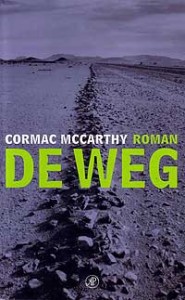
Just as All the Pretty Horses was a Western taken to extremes, The Road borrows from science fiction the struggle to survive after the apocalypse. It’s a plot as well known from movies (Mad Max) as from books (The Handmaid’s Tale); often it’s a way of rearranging society to question our own arrangements. But for McCarthy, it’s a way of taking life down to its bones. He strips away social bonds, yielding a bare stage on which to dramatize physical sensations (thirst and the slaking of thirst, cold and a fire, hunger and the taste of peaches) and elemental emotions. McCarthy is a sensual writer seeking extremes of sensation. He’s a theatrical, even bombastic writer, and he’s made a barren heath for King Lear to rave on. He favors adventure stories, and he’s written a millennial On The Road. He broods on fate, and he’s given man a reason to shake his fist against God.
The travelers in The Road are a nameless father and son, going south in hopes of living through the winter. The war that destroyed the world, or at least their part of it, the American South, has been going on for years; the boy, who is about eight, was born a few days after it began. We do not know how they have survived for so long, though we learn that the boy’s mother has committed suicide rather than live on. On foot, pushing a shopping cart, they follow a carless highway through forests and over burned stretches, sleeping in abandoned houses or under those handy overhanging rocks, watching out for the thieves and cannibals who are the only humans left.
They’re still alive, but to what purpose? The violence is so Biblical in scale (and in origin—McCarthy hints that the war was a sectarian one) that humans seem capable of nothing else. We see no restoration of social bonds, no little community banding together to have children, grow food, and regenerate the earth. The only groups the travelers meet are marauding companies of cannibals or, horrifyingly, prisoners about to be eaten. The only family they encounter commit a similar crime.
“We’re not survivors,” the mother says before she departs. “We’re the walking dead in a horror film.” Bodies lie everywhere, scorched or mummified, “shriveled and drawn like latterday bogfolk, their faces of boiled sheeting, the yellowed palings of their teeth.” The war, the man muses, took all social questions with it. “The frailty of everything revealed at last. Old and troubling issues resolved into nothingness and night.” The most sensible thing for the living to do, McCarthy suggests at various points, would be to die. The father considers the two bullets, then one bullet, left in his gun.
The man keeps going for his son’s sake, but he’s a selfish father, not a heroic one: he makes his son endure so that he himself will have an excuse for hope. McCarthy, who is 73, also has a small son; The Road is a Doomsday Book of paternal fears, but it may specifically be about an old man’s foreboding of death, his late, anxious joy in a young life, and his sorrow at his child’s going on alone.
Are we the good guys? the son keeps wanting to know. Yes, the father answers, but this is more reassurance than truth. The father rejects cannibalism, but to his son’s distress he refuses to risk their lives to save others. It is the son, not the father, who is still capable of horror at the dead or compassion for the living. The father has fed the son optimism, keeping none for himself.
Whatever you think of McCarthy’s view of human nature, The Road is a spectacular example of his storytelling skill. He is a remarkable stylist, a writer of long, rolling sentences; he’s often compared to Faulkner, Melville, Conrad or, in his more exaggerated moments, Thomas Pynchon. If you like realistic novels and straightforward prose, you can skip McCarthy and no one will hold it against you. (That said, the writing in The Road is relatively economical. Here at the end, even words seem in short supply.) But if you’re capable of suspending disbelief and going with him, he can draw you willingly into subjects you never thought you enjoyed: horses, whorehouses, knife fights in Mexican jails, the war of all against all.
Another writer McCarthy resembles, oddly enough, is Tolkien. Like Tolkien, he can evoke fictional worlds so intense, compelling, and fully imagined that you don’t read a book so much as enter it. (It’s probably for this urgency and sureness that McCarthy has such a devoted following, almost a cult status among his fans.) Like Tolkien, he takes us on quests, leaving the women behind. And the two writers share a terrific feel for the rhythm of a story. The Road speeds up (they encounter bandits and make a narrow escape), slows down (they plod along, food gone, starving), then flows suddenly into a calm, hidden pool (they find a stash of food and a place to rest, waking up to the startling normalcy of coffee, ham, and biscuits for breakfast). Often the moments of rest come in dreams or memories: a bleak depiction of what is will be followed by an idyllic glimpse of what was: brothers and sisters doing homework by a fire, or “the flash of trout deep in a pool…Reflecting back the sun deep in the darkness.”
The Road is a strangely beautiful book, despite or maybe because of its bleakness, which forces McCarthy to confess a love for the mundane: here pleasure is not in the mad trip across the wilderness but in the memory of home and warmth. We aren’t allowed to forget at what price warmth came. Coming to an antebellum mansion we’re told: “He held the boy’s hand and they crossed the porch. Chattel slaves had once trod those boards carrying food and drink on silver trays.” He is telling us how fragile goodness is, and, paradoxically, how much of it we still have to lose.
On the road, father and son meet an old man who calls himself Ely; he represents the prophet Elijah, who is forecast to return on Judgment Day. Ely tells the father, “Things will be better when everybody’s gone.”
Better for who?
Everybody….We’ll all breathe easier…When we’re all gone at last then there’ll be nobody here but death and his days will be numbered too. He’ll be out in the road there with nothing to do and nobody to do it to. He’ll say: Where did everybody go? And that’s how it will be. What’s wrong with that?
When the father suggests that his son might be a god, a young Prometheus carrying the fire of human life, the old man tells him it wouldn’t matter if he was: “Where men cant live gods fare no better. You’ll see.”
Yet McCarthy can’t bring himself to reach the end of the road in darkness. “Goodness” will save them, the man tells his son, his young Prometheus; it has before and it will again. We fear it’s another lie, to give his son hope; but at the same time it’s all the hope McCarthy has to give us.
Trouw, February 25, 2007. Cormac McCarthy, The Road (New York: Knopf, 2006); De Weg (Amsterdam: Arbeiderspers, 2007).