
War was Vonnegut’s subject, but not one that came easy to him. It was, it seems, a subject that got hold of him, one that wouldn’t let him go until he tossed out all his beliefs and saw the Second World War as it really was…
http://www.villagevoice.com/2008-03-25/books/war-and-pieces/
Michael Thomas: Man Gone Down
You’re bright, thirty-something, and haven’t lived up to your promise. You wanted to be a poet. Now you teach writing and can’t finish your novel. You live in brownstone Brooklyn, in a neighborhood of young white professionals where you are stared at for your skin color. You have three small children and can’t come up with the tuition for their private school. What was the promise, anyway, that you were supposed to live up to?
The nameless, black narrator of Michael Thomas’s first novel, “Man Gone Down,” is broke. He has four days until he is to join his family at his white in-laws’ summer house. During that time he must come up with $12,000 to rent a new apartment and pay the children’s school bill. While he wanders New York, trying to secure his family’s place in the middle class, Thomas narrates his past and present in a fluid, complex story with shots of intense, virtuoso prose.
“It is a strange thing to go through life as a social experiment,” he tells us. Growing up in Boston, he was a poster child for school integration. He won the prize, a scholarship to Harvard, but felt lonely, shut out, humiliated by the groups to which he was expected to belong. The higher the emotional price he paid, the less he felt he deserved his success. “I remember the strange feeling of being both conspicuous and peripheral—an outside insider—not at all prepared for claiming and maintaining a place within the loop. I was waiting—test scores and potential aside—to be revealed as a fraud.”
His best friend Gavin was white but equally marginal, a would-be writer with a working-class Irish background and an alcoholic father. By adolescence, both were drinking heavily to drive away their uncertainty. At the start of the novel, the narrator has not touched a drink in 16 years, but Gavin is just out of detox, while another friend is schizophrenic and living on the streets.
During four anxious (but non-alcoholic) days, our narrator takes us on a remarkably acute guided tour of class and race in New York City. I can see why “The New York Times” called “Man Gone Down” one of the year’s five best novels: Thomas sees straight into New Yorkers’ souls. Living as he does at the very center of the city’s overlapping Venn diagrams—black/white, rich/poor, bohemian/banker—he is perfectly placed to observe its social patterns. He works construction jobs alongside Latinos and West Indians, bossed by Poles. He sings Dylan covers in a bar. (“I’m going to be the first big black man to sing like a skinny white guy.”) He observes the young lawyers of Cobble Hill, the mothers drinking coffee in on Atlantic Avenue, the parents of school friends. He talks with the Ferrari-driving son of an Italian construction worker and a black law student pursuing a future that money can buy.
“Man Gone Down” is clearly inspired by Ralph Ellison’s 1952 novel “Invisible Man,” about a nameless black man on a political and spiritual journey through a racially divided America. But America is both less and more divided than it was then, and Thomas must look both at the obstacles to success and its dubious rewards. An admirer of T.S. Eliot, he doesn’t want to become a Prufrock, a white-collar drone among people who seem to him shallow and false. His epic journey up from poverty and self-destruction demands a more satisfying payoff than a brownstone and a closet full of suits. He thinks to himself, “It occurs to me not to ask about the dream deferred, because almost everyone knows what it is, on some level, to fail. But what happens to a dream, and yes, a dream, not a desire or hankering or an impulse or a want, but a dream, realized?”
Despite all the literary references, Thomas makes this novel of an artist’s (late) coming of age completely his own, sidestepping or subverting all the clichés of the genre. You never feel like he’s relying on received wisdom; it all feels both new and intensely observed. Much of it is autobiographical—Thomas is black, has a white wife and three children, lives in Brooklyn—but that in itself is no guarantee; Thomas views his surroundings with a keen eye. The book’s one fault is that it’s too long for the relatively minor events that take place: a racial slur that leads to a fistfight, an unsuccessful seduction, a dinner party, a game of golf, the death of a goldfish. Like other recent books in English mapping middle-class racial identities (Zadie Smith’s “On Beauty,” Colson Whitehead’s surrealistic “Apex Hides the Hurt”) it conveys uneasy relationships in fascinating detail, but sometimes at the expense of plot.
Some of the novel’s tension comes from the narrator’s desire not to fail his children, who represent, literally, his attempt to live in both black and white worlds. Being a good parent isn’t a banal, bourgeois ambition for him, but compensation for his own fatherless childhood. He fears he is too “damaged” (his word) by prejudice and poverty, and he fears what racism has in store for his kids. His older son, known as C, is dark-skinned. The younger, X, “looks exactly like me except he’s white. (…) I sometimes see the arcs of each boy’s life based solely on the reactions from strangers, friends, and family—the reaction to their colors. (…) X’s blue eyes somehow signify a grace and virtue and respect that needn’t be earned—privilege, something that his brother will never possess.”
He briefly considers leaving his wife and children and starting over, but it’s clear he’s not serious. An immigrant to the middle class, he may never feel at home in his wife’s privileged world. Yet his wife—as a person, not a representative of a class—is his lodestar, his beacon, his safe haven. At the end of the novel, improbably successful in his quest, he rejoins his wife, and together they watch their three new social experiments sleeping in the back of the car. “I start to face forward, but I turn back, take one last look at my own: the boys, I hope, dreaming in their own hue and time and my girl in the fading light; the little, changing face of love.”
Trouw, February 23, 2008. Michael Thomas, Man Gone Down (New York: Black Cat/Grove/Atlantic, 2007).
Now, in 2014, I can see that this review was too New York-centric for Dutch readers. I was assuming too much knowledge of New York City and of the way Americans think about race. I’d like to think I’ve gotten better since then at translating from one culture to another, but I always have the gnawing feeling something’s getting lost—the same feeling that “Man Gone Down” illustrates so well.
A year after “Man Gone Down” was published, Joseph O’Neill wrote about the same—endlessly interesting—themes from the point of view of a white, European banker. His book, “Netherland,” reached a much wider audience. Funny how that works.
Out of Milk? Live With It
Harvey C. Mansfield and the Perils of Equality
Equality between men and women was the feminist ideal. It was our utopia. Now that my husband and I have achieved something like it, on a one-household scale, I can see that in some ways it’s a pain in the ass.
Equality is terrifically inefficient. There are always too many cooks in our house, too many decisions made by argument and committee. “Who’s going to the store? How much milk do we need? What do you mean you can’t find it? Do you have time to pick up the kids today? No? Do you think your work is more important than my work?”
It’s infinitely easier to divide up the tasks, setting up little fiefdoms of expertise. We’ve tried that too: one of us does all the carpentry, grocery shopping, and vacuuming, while the other takes care of cars, computers, cooking, and the laundry. But it means that we’re helpless in each other’s world: confronted by a TV remote or a child’s underwear drawer, we panic. I understand, now, all those widowers who can’t boil water and divorcées who don’t know how to pay the bills. It’s the price of a system that, when it works properly, makes perfect sense.
Roles are easier to cope with and to understand—which might explain something else about household equality, its invisibility. On the one hand, there’s nothing more attractive to many women than a man wearing a baby in a carrier. On the other, in the great debate over women’s work, men who do contribute to the household work simply don’t exist. In real life, I look around me at the parents I know—not just the artistic types but the software engineer, the house painter, the plumber—and everywhere I see men working part-time and caring for their children. [Part-time work is much more common in the Netherlands than in the US, and is especially popular with working mothers.] Yet anyone who steps out of the statistical pattern is not only undervalued but unseen.
Giving men and women back their fiefdoms, and their recognition, is the goal of “Manliness,” by the philosopher Harvey C. Mansfield. He believes that roles work better than improvisation, and that they are actually better at allowing people to be themselves. He doesn’t want to spend his life negotiating and explaining his motives. He feels that men are naturally confident, aggressive leaders who should not be asked to do “women’s work” or be judged by female standards.
Mansfield, 75, teaches at Harvard University, where, in the relatively progressive American academic climate, he stands out for his conservative politics. A writer for neoconservative journals and nurturer of that movement, he advocates for a strong presidency and has written books on Machiavelli and Edmund Burke. In “Manliness,” he has clearly tackled a hot issue: the book has been widely reviewed, he has been much in demand as a speaker, and now, two years after its American publication, the book is being published in Dutch translation.
It’s a sign of the need for a book like this that it’s been so popular, because there’s not much enlightenment to be gained from actually reading it. Between the brief definition of manliness at the beginning (aloofness, authority, “confidence in the face of risk”) and its defense at the end, there lies, like the gray meat of an unappetizing sandwich, a long discussion of philosophy and literature that is vague, tedious, self-contradictory and occasionally wrong.
Mansfield begins his defense of manliness by rejecting all evidence from psychology, anthropology, and even biology. The social sciences, he contends, are inaccurate, inadequate and full of hidden agendas. This is typical of American neoconservatives, who on the whole have no patience for empirical evidence. Ultimately, science as a whole fails his test: intellectual rigor is not manly.
Instead he seeks in his own field, classical philosophy, and comes up with Aristotle’s thymos, which Mansfield describes as “spiritedness,” “bestial courage,” and bravery in self-defense. Thymos is “what gives us personal pride and makes us individuals.” It is George W. Bush’s “stay the course” and a street kid’s demand for respect. As Mansfield uses it, it might also be translated as “underbelly,” and he admits that it is not appealing unless tempered. He says over and over again that male aggression is both a positive and a negative force. But like a junkie, he is willing to ignore the side effects for the rush.
Set against this manliness, and poised to undermine it, is feminism, which Mansfield sees as enemy number one. He has been teaching at Harvard since 1962, long enough to be battered by several waves of the feminist movement; I bet it hasn’t been easy. But that’s no excuse for his drastic misrepresentation of the feminist project. The goal of feminism, he claims, is women’s independence from men and children. Most of what’s been written about women’s desire to combine work and family he disregards, noting only that American women have suggested government-subsidized day care. But he can’t imagine why women would “put their trust in impersonal bureaucracy rather than in a man who loves them.”
His worst-case scenario is “the gender-neutral society,” by which he means, as I understand it, a flattened existence of people who compete with each other at work and suffer at home, because the men can’t express their true nature and no one wants to do the housework. Because bravery and risk-taking are frowned on, he fears, no one will achieve anymore. We are, he says, “downsizing greatness to ‘individuality.’” Instead, he feels we should permit men, and the occasional woman (Margaret Thatcher), to be manly, while requiring women to be responsible for manliness. They should appreciate it, allow themselves to be protected by it, and gently correct its excesses.
In fact, feminists don’t seek a sexless society; they seek a society in which they are not automatically, because of their sex, allowed less opportunity. There should, you’d think, be plenty of room for heroism here. But certainly the equality model, with its improvisations, compromises, and arguments over the groceries, is complex. Mansfield can’t see a pattern in it, and so it looks gray and dreary to him.
Of the examples of manliness that he gives, few come from this contested ground that is real life. They mostly come from the world of art: Achilles, Tarzan, Gary Cooper in “High Noon.” They’re often quite appealing examples; the problem is, they’re imaginary. They are our fantasies about what men should be, not our knowledge of what they are. They’re also selectively, deceptively chosen: you’ll find Rudyard Kipling’s poetry of empire, but not his grief-stricken rejection of the warrior ideal after his son was killed in France in 1915. Nowhere mentioned in “Manliness” but everywhere between its lines is the Iraq War, a real-life example of what happens when Mansfield’s manly qualities—excessive risk-taking, disregard for the evidence, inability to tell fact from fiction—are put into practice.
If there’s a strong strain of nostalgia in “Manliness,” it’s not entirely because modern society has tamed all the heroic males. It’s also because the greatest heroes have always lived in the past, which is another way of saying, in our fantasies. Far older than feminism is the ubi sunt lament, in which the poet cries, “Where are the young warriors who went before us? Where is the great lord, the giver of gifts? Alas, he is gone, I am alone.”
And so Mansfield cries, “Where is John Wayne? Where is Teddy Roosevelt, the great hunter? Where is my boss at Harvard, Larry Summers? Alas, he had to resign because he said women couldn’t do math. Will his like ever be seen again?” It isn’t that Mansfield himself wants to do great deeds; he longs to sit at the feet of a man greater than himself. He wants to serve the alpha male.
In his discussion of feminism, Mansfield accuses Simone de Beauvoir of nihilism—Nietzsche’s “will to nothingness”—because she prefers the unknown future to the options that women already have. It’s true that we don’t know what’s there, but that doesn’t mean we can’t, in Mansfield’s terms, take the risk and embrace it. Equality may be a messy nuisance, but it still feels more real and more forward-looking to me than any of Mansfield’s elegant fictions. If it means sometimes running out of milk, then, heroically, I’m willing to pay that price.
Trouw, January 19, 2008. Harvey C. Mansfield, Manliness (New Haven: Yale University Press, 2006); Mannelijkheid (Amsterdam: Meulenhoff, 2008).
Germaine Greer: Shakespeare’s Wife
Germaine Greer leads a double life. We know her best as a tricky, funny, impossible feminist provocateur, liable to stand up at any moment and announce that contraception is bad, female genital mutilation is acceptable in an African context, or that Princess Diana was a “devious moron.” But she’s also a professor of literature who wrote her Ph.D. thesis, at Cambridge, in 1967, on Shakespeare’s comedies. In 1986 she published an eloquent literary essay titled simply “Shakespeare.”
The roles of gadfly and Shakespeare scholar might seem difficult to combine, but the resourceful Greer has found a way. The wives of famous men, she points out, do not always receive kind treatment from posterity. Biographers prefer stories about an artist whose brilliance went unappreciated by a difficult or foolish spouse. So Greer—who is the kind of writer who thinks in disagreements—has decided to write a biography of her own. Her goal in “Shakespeare’s Wife” is to rehabilitate the much-maligned Ann Hathaway.
“Biography” may be too big a word here, since we know almost nothing about the career of England’s greatest playwright, let alone the woman who, Greer says, “left a wife-shaped void” in his life story. They were both born in Stratford-upon-Avon, she in 1556, he in 1564. They were betrothed in 1582, and by 1585 had had three children. He then disappears from the records until 1592, when he turns up on the London stage. In about 1613 he returned to Stratford, where he died three years later at the age of 52. Aside from one mysterious book dedication, he never wrote anything in his own voice. No letter survives from his hand.
Aside from the many theories that Shakespeare didn’t actually write his plays (none of which Greer believes), the blank page of his life has also generated wild speculations about his marriage. The assumption that it had always been an unhappy one is largely based on the fact that for most of his life, he and his wife lived apart. It also has to do with the circumstances of their marriage: she was 26 and he only 18 when they wed, and their daughter Susanna was christened only six months after the ceremony. Ever since this last fact was discovered in 1836, Greer writes, biographers have assumed that an older woman, “past her sell-by date,” seduced a handsome boy who, after their “roll in the hay,” was marched off to church. In the 20th century, when male artists were warned not to get tied down with the “ball and chain” of marriage, it was easy to picture for Shakespeare a life full of “disappointment, frustration, and loneliness.”
And yet, Greer says, “Shakespeare is above all the poet of marriage.” The marriage plot, in which a couple find each other through all kinds of hindrances—mistaken identity, parental interference, foolish choices, even the gratuitous meddling of fairies—is Shakespeare’s stock-in-trade. It is, Greer argues, largely his invention. Of course, a writer of romantic comedy doesn’t have to be happily married—look at Jane Austen, who wasn’t married at all. But the (equally unpartnered) Greer argues that Shakespeare writes too sensitively and with too much understanding about the married state to have actively disliked his wife.
So Greer decides to play what might be called “angel’s advocate.” If others can speculate on the disasters of the marriage, she’ll counter, tongue lightly in cheek, by imagining it in the best possible light.
In his time, Greer points out, Will was a little young for marriage, but Ann was by no means too old. Middle-class Tudor couples, like their modern equivalents, were expected to marry well into their twenties, after they had learned a trade and saved enough money to set up a household. In addition, betrothed couples were allowed and even expected to sleep together before the wedding and be expecting at the altar. There’s no reason to think Ann’s pregnancy was an accident. And even if they did live apart for many years, he bought a large house in Stratford—where she presumably lived—and returned to spend his last years with her.
Could Ann read Will’s work? Nowhere did she sign her name, but according to Greer, we shouldn’t assume she was illiterate. Many women who couldn’t write did read. Along with the Bible, they were active consumers of the chick lit of their time, half-penny romantic ballads that were sold by the sheet and sung over the spinning wheel. Greer imagines William teaching Ann her letters, and comments, “In his plays he is very well aware of the erotic dimension of the teaching situation.”
So what was she doing while he was away in London? Greer believes she was busy overseeing his financial affairs, restoring his house, and supporting their family: “Tudor women enjoyed a measure of economic independence that would not be equalled again until our own time.” In “A Room of One’s Own,” Virginia Woolf called for a history to be written of Elizabethan women’s lives, as a way of discovering the fate of the woman she called “Shakespeare’s sister” who never got a chance to write. For much of the book, Greer does just that—but not to show how women’s writing got lost. She uses Ann’s life as a frame on which to hang an enormous accumulation of information on what Elizabethan women did instead, from spinning wool, birthing babies, and brewing beer to lending money and organizing protests against landowners.
In her later feminist books, Greer has celebrated the joys of pre-industrial life, and some part of her clearly would like to be Ann, the sturdy farmer’s daughter who doesn’t need a man. (Celibacy for older women is part of Greer’s feminist program.) Other familiar Greer ideas reappear in “Shakespeare’s Wife.” In “The Whole Woman” (1999), Greer criticized the “patriarchal medical establishment,” so it makes sense that she dislikes Ann and Will’s son-in-law, a Cambridge-educated doctor who, she claims, rode around the countryside physicking the rich while “experienced women like Ann Shakespeare attended childbeds and deathbeds and gave preliminary treatment.
How does all this information add up? It doesn’t. Adding up isn’t what Greer does. She can write a wonderful, wise, funny sentence, and she can make an excellent point, but she has never been good at either building a narrative argument or telling a story. The Greer of “Shakespeare’s Wife” is not the maker of outrageous remarks, but a learned and engaging professor who occasionally goes on too long about her passion for genealogy.
Every once in a while, Greer lets Ann Hathaway be more than just a collection of facts and averages. She misses her beloved Will, “especially in the long dark winter evenings, when she sat working by the dying fire as her children slept.” She keeps her tongue when the Stratford gossips inquire after her missing husband. She blushes when young Will reads aloud from his erotic poem “Venus and Adonis.” During his final illness, she reads to him from her Bible.
But every time Ann and Will start to become characters in a story, Greer quickly pushes them back again behind a scrim of “if”s. She refuses to pretend that she knows who they are. She reminds us again and again that we don’t know, that all we can do is look at what was possible for men and women in Elizabethan England. Oddly enough, this is an important part, not only of the book’s, but of Greer’s own appeal. Greer the feminist is opinionated; Greer the scholar doesn’t pretend to have a lock on the truth. When she’s being a diva, she’s impossible. When she’s excited about the 16th century, and not her latest life crisis, she’s still erratic and untrustworthy, but also witty, enthusiastic, and passionate about literature.
A Pre-industrial Paradise
Germaine Greer (Melbourne, Australia, 1939, moved to England in 1964) received her Ph.D. from Cambridge in 1967 with a thesis titled “The Ethic of Love and Marriage in Shakespeare’s Early Comedies.” At the time she was a self-professed anarchist whose own marriage, in 1968, lasted three weeks, during which she was unfaithful several times. In her later feminist books, particularly “Sex and Destiny: The Politics of Human Fertility” (1984, written after she discovered, to her disappointment, that she couldn’t have children) and “The Whole Woman” (1999), she appalled many of her colleagues by fantasizing about pastoral society as a paradise for women. She now lives in a farmhouse in Essex where she keeps dogs, geese, and doves. She also appears frequently on television in the UK, where she is beloved (and reviled) for her combination of wit, vitriol, and disarming charm.
Trouw, Amsterdam, January 12, 2008. Germaine Greer, Shakespeare’s Wife (London: Bloomsbury, 2007); De vrouw van Shakespeare (Amsterdam: Meulenhoff, 2008).
Explorer, Archaeologist, Librarian, Spy
“The Dangerous Book for Boys” meets “The Daring Book for Girls”
Our 5-year-old daughter is angry. At bedtime we’ve been reading out loud to her from Donald Duck comics. But now her 8-year-old brother is jeering, “Girls can’t be in the Junior Woodchucks. The Junior Woodchucks are for boys. The Chickadees are for girls.” That seems fair: one scouting group for boys, one for girls. But since the stories in the comics are never about the Chickadees, all my daughter can do is withdraw in tears of frustration. She doesn’t belong to the club that counts.
I don’t give feminist lectures at home; I don’t want to ruin anyone’s fun. But it doesn’t take a girl to see that the stories aren’t fairly divided. “Where are the women superheroes?” my son once asked me, in all innocence. “Good question,” I said.
What can you do if you’re a girl? You can try to participate in boys’ things until your nose bumps up against the ways in which you’re being left out; or you can form your own club and discover that you’re still not being taken seriously. You can read Donald Duck and be left out once a week, or you can subscribe to Katrien, the girls’ edition, which only comes out six times a year. The editor-in-chief of Donald Duck said recently in an interview, “Comic books are a guy thing.” It’s true. But is it chicken or egg?
Lately both men and women seem to have grasped, with the grim determination of a mountain climber clinging to a rope, the theory that boys and girls are biologically different. Finally we don’t have to pretend to be what we’re not, is the relieved, or irritated, logic. Not only does innate difference often seem to work as an explanation, it’s genuinely restful. If you’re a woman, you can give up changing bicycle tires; if you’re a father, you can quit keeping track of your children’s socks. If you are a girl, you can plead for My Little Pony toys and actually get them; if you are a boy, you can let your dolls, or rather, “action figures” ax murder each other. Why waste time doing something badly when your entire sex seems to be doing something else well? Efficiency is a virtue these days, and no one wants their children to fail.
One thing is clear: difference is a gold mine for marketers. My brother and I had a toy castle as kids; but when I went to look for one for my own children, I couldn’t find a unisex fortress. Now castles come in boy editions (gray and fierce) and girl editions (pink and lacy). The knights rule one realm, the princess another, and the toy company chalks up two more sales.
There’s a notion of encouraging boys that plays into this, too. It’s sometimes argued that boys don’t fit into the too-feminine, over-organized world we’ve made for our children, that they need to see positive images of themselves, that they no longer have anything of their own. Fine, that makes sense.
But if women are sometimes a bit more wary of gender divisions than men are, it’s because so often the game turns out to be slightly rigged against the girls. For example: The New York Times recently reported on a large management study that showed that however women behave in the workplace, it’s never right. Qualifications for the ideal manager vary from culture to culture. In Britain, “inspiring others” is seen as most important, while in Norway, it’s “the ability to delegate.” But there was one consistent result: whatever was valued most, women were perceived to be less good at it. And if women were good at a particular task, then that task was given less value.
All this doesn’t mean there’s anything wrong with the UK and US best-seller The Dangerous Book for Boys, now published in Dutch as Het Jongensboek. Written in a lively, accessible style for boys around age 12, and meant to promote independence and adventurousness, it’s full of all kinds of worthwhile information. It instructs preadolescents in how to tie knots, write messages in code, provide first aid, do coin tricks, skip rocks, and talk to girls. It teaches them how identify trees and insects. It includes sections on fossils, astronomy, history, and the rules for football and marbles. It contains accounts of famous battles in history (a subject I found morbidly riveting as a child) and instructions for how to shoot, skin, clean, and cook a rabbit. It reminds me of the illustrated science books my brother and I had as children, like the geology one, with its cutaway illustrations of hillsides and volcanoes, showing the geological layers, and its lurid, enticing color photographs of gems.
The “dangerous” in the title is a bit misleading. Aside from chapters like “The History of Artillery,” much of the information is scholarly and canonical: here are poems every boy should read, Latin phrases, the parts of a sentence (grammar, very good) and rules for spelling. With its art nouveau cover, recalling children’s fantasy books circa 1900, the book is as old-fashioned inside as it is out. One’s wariness is eased by the realization that, aside from the rabbits (which have been left out of the Dutch edition), this is pretty square stuff. My husband, who was curious enough to buy the American edition, was disappointed. “Where is pop culture?” he muttered. “Where are the Beatles?”
With its focus on history and literature, the Dangerous Book lends itself to a harmless form of national pride. The book’s adapter, journalist Hans Hoekstra, has taken the opportunity to fill the Jongensboek with Dutch and Flemish history: great navigators and inventors, the Eighty Years’ War, 120 years of bicycling in the Lowlands. Shakespeare has been replaced with Multatuli, Hastings with Heiligerlee. Bits of the new Canon of Dutch History are explained: who or what were Hebban olla vogala, Eise Eisinga, Annie M.G. Schmidt?
It’s fascinating, all of it—exactly the kinds of things I’d want my kids to know. The whole book radiates a warm, safe feeling of solidity, learning, and old-fashioned values. There’s just one burning question: what’s left over for the girls? Do we get half? If we ask for half, will everyone hate us for spoiling the boys’ fun?
At least two equivalent books for girls have appeared this year, one in the UK, the other in the US. The British version, The Great Big Glorious Book for Girls, has stirred up controversy for presenting an old-fashioned view of girlhood. It contains instructions on knitting, baking, braiding hair and how to do a stage faint, and explains, “Boys are physical, girls are emotional.” Instead, Dutch publisher De Harmonie has chosen to translate the American version, The Daring Book for Girls, by Andrea J. Buchanan and Miriam Peskowitz.
To my pleasant surprise, the Daring Book is just as useful as the Dangerous. It gives the rules of basketball and darts. It tells how to care for your softball glove, read a tide chart, paddle a canoe, fill a toolbox, and make a willow whistle. It gives math tricks, prints the Periodic Table of the Elements, lists women inventors and political leaders. It has some traditional girl stuff, too, like jumping rope and pressing flowers. (“Hey, pressing flowers, good idea,” said my husband, who studied biology.) And it has useful tips for the future, like how to negotiate your babysitting salary. While it still has a pop culture gap, it’s actually better and more useful than the boys’ book, at least if you’re an urbanite with no place to use a homemade go-cart.
In fact, almost any of these activities could have been in the boys’ book, or vice versa. And that, it seems to me, is the real trouble: to put a fence around one set of things and mark it “boys,” and another fence around “girls,” may be restful for a while—and it will certainly sell more books. But there’s always going to be someone who doesn’t fit. And then what? “It’s not bad to say girls and boys are different,” my husband commented. “But if you glorify or wallow in those differences, you’re in danger of undoing 40 years of feminist work.”
It’s the old-fashioned, blissfully nostalgic look and feel of this particular book for boys that makes it so popular, I suspect—but not necessarily because its readers are anti-girl. It also recalls an era when it was clear what we were supposed to learn, when grammar, history, literature, and science all mattered, when children were supposed to fill their heads with facts and dates, when they were encouraged to know what words meant and how to spell them.
It’s interesting that the quest for a literary and historical canon, the hunger for a Dutch national identity, and the longing to find immutable differences between men and women have all come into play at the same time. The pendulum has swung from “everyone is the same” to “groups are different.” We’re more interested right now in the rule than the individual, in solid footing than experiment.
Speaking for myself, I love traditional knowledge. I don’t want it to be thrown out. I think history is fascinating, even in the centuries when my sex doesn’t appear in it. I want to know about the voyages of Abel Tasman and the battle of Waterloo. I want a place of honor for Shakespeare, and I’m willing to accept a lesser role for women, if I must, in order to acknowledge his importance.
But must I? This is the less useful aspect of a canon, the way it has to exclude something (women, people of color, the Beatles) in order to be taken seriously, in order, in fact, to be a canon at all. Women and minorities water down the list. To include among the historical adventures a bold tale of escape from slavery would be immediately to open yourself up to charges of political correctness, i.e., lack of seriousness, no matter how thrilling the story actually was. At the same time, I suspect that the Daring Book is more appealing partly because it does show alternatives to that old-fashioned narrative of guns, heroes, and Latin phrases. (Not surprisingly, the girls’ book is somewhat less blindingly white than the boys’ one.) As important as general knowledge is, there are times when even men can be happier the edges than in the middle.
One thing I didn’t see in the girls’ book that I might have included is a section on archaeology. To be an archaeologist is an ambition of many preadolescent girls, along with the closely related professions of librarian and spy. These are fantasies, I think, about access to knowledge. Girls want to own the world of books. They’re drawn to secret information. They want to know what lies hidden beneath the soil. When girls can’t see themselves in the world of official knowledge, they search underground.
Still, I hope my daughter won’t have to look for her place in the world beneath the earth or in the dark. As my husband points out (so you don’t think I said it and call me a spoilsport), “Letting go of rigid gender roles has made the world a lot more confusing. But it also feels more like real life.”
Genghis and Jane
The writer of The Dangerous Book for Boys, Conn Iggulden (1971), is more conservative in interviews than in the book itself. The author of the Emperor series of historical novels about the life of Julius Caesar, and of a new series starring Genghis Khan, Iggulden comes down strongly on the “boys are different from girls” side of the debate. “You only have to push a boy on a swing to see how much enjoys the thrill of danger. It’s hard-wired.”
When an interviewer suggests that a boy might be drawn to a female role model such as Jane Goodall, he answers, “The simple fact is that boys are inspired by stories of men being courageous and self-sacrificing much more than Jane Goodall and her chimps.” Given the complexity of the gender debate, statements containing the words “hard-wired” or “the simple fact is” feel reactionary, no matter what the content. And yet Iggulden has also said that his favorite book as a child was The Secret Garden, and that it was his mother who gave him his interest in history.
His main concern, he says, is that kids are overprotected, and that we are producing “a generation of soft, pale, chubby boys afraid of their own shadow.” Once the culprit for “unmanly” men was overbearing mothers, now it’s computer games and the Internet—as if we can only escape the influence of the Internet by adopting old-fashioned, pre-broadband gender roles.
The authors of the US Daring Book for Girls seem determined, in interviews, not to get involved in the difference debate. But the authors of the British Great Big Glorious Book for Girls have said that they are happy to propogate traditional gender roles. Co-author Rosemary Davidson told the Times (UK), “While it is clearly [seen as] okay to endorse, or celebrate macho ideals – as Dangerous does – I do wonder whether girls should be genderless. Glorifying boyhood is good, but it is somehow wrong to know how to make a doll.” Statements like this led Lynne Truss, in a Times review, to comment that Glorious is “an incredibly perplexing book masquerading as a simple one.”
Trouw, November 24, 2007. Donald Duck comics are wildly popular in the Netherlands.
Michael Chabon’s Open Gate
In the Washington Post, I talk to Michael Chabon about genre, literature, and his adventure story “Gentlemen of the Road.”
Jewish Detective Stories: A Talk with Michael Chabon and Daniel Mendelsohn
What constitutes a cultural identity? Is it connected to home, to language, to being part of a group, to being on TV? Is it tied to history? Can history be rewritten? Novelist Michael Chabon and culture critic Daniel Mendelsohn have both published books in which they look at identity and its representation through the lens of an Eastern European Jewish heritage. Chabon and Mendelsohn both happened to be speaking in Amsterdam last week, and the two friends agreed to a joint interview.
As American Jews, they both feel relatively free to play with their cultural heritage, picking and choosing elements of that heritage to combine with their other interests. For Chabon, those include myth, comic books, and popular culture. His new book “The Yiddish Policemen’s Union” is a mystery novel set in an imaginary Yiddish-speaking colony in Alaska.
Mendelsohn was a classical scholar specializing in Greek tragedy before he became a journalist. In 1999 he published “The Elusive Embrace: Desire and the Riddle of Identity,” about relationships among gay men. In his 2006 book “The Lost: A Search for Six of Six Million,” he describes his attempts to discover the fate of his great-uncle, great-aunt, and four young cousins in a small town in Poland during the war. “We both wrote detective stories,” Mendelsohn says. “But we also wrote about language, about narrative, about options that are available to one as a writer, to choose.”
Daniel, in an interview for your previous book, about the gay community, you said, “An ‘identity’ is something we all yearn for but which is bound to elude us, because it is a creation of our desire and fantasy about who we want to be.” Does that apply to Jewish culture as well?
Daniel Mendelsohn The gay “culture”—I don’t like to use that word, but the gay whatever and the Jewish whatever—function similarly in their relationship to the larger culture. There are the same issues of the possibility of assimilation, the desire to remain different; within each group, there’s a perceived form of “extreme” identity statement and a “modified” identity statement. To me, the two things were totally concentric. And that’s how I thought about them; and it has been a very useful way for me to think about culture in general, about the possibility of stance. How can you position yourself with respect to the larger culture? And in that respect, both Jewishness and gayness are metaphors for a way to relate oneself [to the dominant group]. The same debates rage within both cultures: should we assimilate? should we remain outside? What are the benefits? What are the compromises involved?
Michael Chabon Should we allow ourselves to be valued for the things that the larger culture values us for while at the same time it’s devaluing us for many other reasons? The things that Jews, or gays, are reputed to be “good at”—should we accept those labels because they’re positive, or should we reject them completely because they’re being used in a dubious manner?
Mendelsohn Every time there’s a really queeny character on a TV show, there’s 500,000 people saying, “Isn’t it great? We’re on a TV show!” and then there’s 500,000 people saying, “It’s horrible, because most of us are just lawyers and doctors, and we’re not all queeny decorators.” So as a producer of culture, you’re always aware that no matter how you make it, someone’s going to be miserable. When you’re writing, you’re part of the machine of cultural production. And someone’s going to be saying the same thing about you. “How could you make Jews this way? How could you make Jews that way?” It’s always a vexed issue.
Michael, I was interested in how you talk about home and homelessness in “The Yiddish Policemen’s Union.” I don’t live where I’m from, and I moved around a lot as a child. I found the most poignant parts of “The Yiddish Policemen’s Union” to be the ones where you’re wondering whether or not you need a home to be yourself, even to be a person.
Chabon I’ve always found a lot of meat in the aspects of Judaism that deal with not having a home, longing for a home. The Diaspora, the period of wandering, is what lies at the center of interest for me in Jewish history.
I moved around a lot too when I was a kid. Then in 1970, when my family finally settled down, we moved to a place called Columbia, Maryland. Columbia at the time was a brand-new city. It was being built from scratch, and it was very much being done along Utopian principles from the 1960s: racial equality, religious, ecumenical, people worshipping together in the same building, sharing one building regardless of what faith you were, trying to ease class disparities in the way housing was designed. And my parents bought into Columbia not just because they could get a nice house for a reasonable price, but because they believed in it. And I grew up very much believing in it; that was my home.
I had this sort of idyllic childhood there, in this Utopian place, up to a point—and that point was when my parents separated and then divorced [when Chabon was 11]. And after that it was sort of broken, for me.
From then on, [I had a] period of feeling homeless in some way, and moving back and forth between my parents’ houses. And then I became a teenager, and was moving all over, and I moved 22 times in 14 years, I calculated it once. I had almost had this moment of being at home, being in this place that was like a kind of New Jerusalem, and then losing it and leaving it—that partly explains why I feel it so strongly.
Mendelsohn It’s always something you write about with tremendous emotion. I still remember reading Kavalier & Clay, and there’s that part at the end where he gets the crate [containing the Golem of Prague], and he smells the waters of the Moldau, and I just was heaving.
Chabon And it’s not just a Jewish thing at all, it’s very much an American thing: rootlessness and restlessness and moving on.
Mendelsohn It’s interesting to be in Europe talking about these books, since my book is about the desire to recuperate a history by somebody who had no history, in the way that Americans uniquely are allowed, or can choose, to have no history. Because you grow up in a suburb that didn’t exist until six months before you were born.
And the idea that we’re all haunted by this parallel life, the life that could have been, the European life, the one you would have had if your grandfather had decided to stay in you know, “Vashkovitz on Fruit” —one is haunted by it, if you have any imagination. It doesn’t matter if you’re a novelist or not, this is something you grow up with. There’s always that floating around: the other life, the alter-life. And so that yearning for home is also a yearning for history.
Michael, did some of Columbia, MD, get into Sitka, the Alaskan Jewish settlement in your book?
I think so, just in the idea that you could take this empty space and fill it, with a city, and say, We’re going to do it, and we’re going to do it like this, here’s where the people are going to go, and … So much of it was about making maps and plans, the building of Columbia, and I got this very potent demonstration of how you went about imagining and then building a place. It happened right before my eyes, and it all started with this map of Columbia. And you know, the books that I loved reading at the time were full of maps. And so the idea that there was this power in imagining a place and mapping it and dreaming it up and then either writing a novel about it, like “The Chronicles of Narnia,” or even actually, if you had all the resources of money and will that the developer of Columbia had, to actually make a real place; that such a thing was possible. I’m sure it fed into my even imagining that I could write a book like “The Yiddish Policemen’s Union.”
Language is another important part of identity, and the most important language in both of your books, although they’re written in English, is Yiddish. For example, Daniel, you transcribed parts of your interviews in the original Yiddish.
Mendelsohn To me it was important, because I wanted the reader to hear the sound of Yiddish, as a kind of artifact. My book is a book about evidence. You’re surrounded by evidence, and it’s visual, and it’s narrative, and it’s aural.
But I grew up hearing Yiddish. It was a very strong component of my Jewish childhood, because I was surrounded by old people whose mother language was Yiddish. It’s an element of this lost civilization that to me needs to be presented, like an artifact in a museum. Because nobody—none of the people who are my kind of people speak Yiddish anymore.
Chabon It’s being lost all over again now, in that not only is there no more Yiddishkeit, no more world of Yiddish—that was lost when we were kids already—but now all those people that passed it on even in the fragmentary way that they did to us are gone, or going, very soon. I’m very conscious of that for my kids. What they know about Yiddish is again an order of magnitude less than what I knew about Yiddish. If my core vocabulary that I had as a kid, just from what I heard [from his grandparents], was, let’s say it was 150 words that I was confident I might know what they meant, for my kids it’s 20 or 25. There’s nobody to get it from but me, and—it’s like in a post-apocalyptic novel, where little fragments of civilization are handed on, but every time they’re handed on another piece is forgotten…
Mendelsohn …is rubbed away a little bit. But that reminds you: the meaning of the word culture, you know, is deeply connected to the life of living things. That’s what culture means. And that’s why I always say, and I get in trouble for saying: you can’t talk about gay culture. Because nobody is born into gay culture. They don’t grow up in gay culture. They don’t have, largely, although it’s changing, children to pass a culture on to. If there are no living people to transmit the object, then it fades away. And that’s what Yiddish means to me.
Look, I’m a student of dead languages. Yiddish is unique in the history of the world to be a language that died in six years. To have a language that is completely in the prime of its health—
Chabon It was at its peak.
Mendelsohn —at its peak, both as a language and as a literature, and then not to exist six years later, is a thing unique in the history of the world, as far as I know.
Chabon In a way, if you have the desire to live in a world where Yiddish is still powerful, vibrant, strong, and all around you, you either have to go where Daniel went or—you have to go where I went.
Mendelsohn Another way of saying that is that if you are not a novelist, the only place you can go for thriving secular Yiddish culture is in the past. And the other place you can go, if you are a novelist, is in the parallel present. And to say that is to say a deeply tragic thing.
Last night [at Mendelsohn’s reading] I was telling the story of a Ukrainian boy I saw in Bolechow [his uncle’s home town] who was playing in the Jewish cemetery. We asked our interpreter, “Does he know what this place is?” and he said “Yes, it’s the Jewish cemetery.” And we said “Does he know what a Jew is?” And he said no. And that just always destroys me. That’s extermination, when people don’t even know what a Jew is anymore.
Amsterdam, September 19, 2007.
Loneliness and Belonging: Miranda July
“The best art and writing is almost like an assignment; it is so vibrant that you feel compelled to make something in response. Suddenly it is clear what you have to do. For a brief moment it seems wonderfully easy to live and love and create breathtaking things.”
—Harrell Fletcher and Miranda July, LearningToLoveYouMore.com
Much of Miranda July’s work, from her early videos and performances to her recent film “Me and You and Everyone We Know” and her current collection of short stories, “No One Belongs Here More Than You,” has explored loneliness and isolation and their opposites, belonging and community. Alongside her own output, she has worked to build artistic networks. The most visible of these is the website LearningToLoveYou More.com, which July and fellow artist Harrell Fletcher began as a sort of creativity generation tool.
The website offers a list of assignments from which participating artists, professional and amateur, can choose—ideas such as “Take a flash photo under your bed” and “Draw a scene from a movie that made you cry.” The “reporters” who post their work on LTLYM range from high school kids to serious artists (or both). Though contributors are encouraged to make use of the trivia of personal lives, the results are seldom trivial or banal. The assignment “Photograph a significant outfit” (“Remember exactly what you were wearing during a recent significant moment….Lay out what you were wearing on the floor, as if you are dressing an invisible, flat person”) yields evocative images, with the empty track suits and jeans hauntingly at odds with the importance of the events.
The site is popular in part because it offers its contributors a sense of community. July has said variously that the site allows her to give back to her fans, that it helps her build an audience for work like her own, and simply that she and Fletcher came up with the idea after they confessed to each other that they secretly liked being told what to do. Certainly part of the intense response to July’s work lies in the encouragement she gives to others: her participatory sensibility seems to act as a magnet to the Internet’s charged particles of longing and belonging.
Work from LTLYM has been shown at the Seattle Art Museum and at the Whitney Biennial in New York; now a new show, curated by students from the California College of the Arts in San Francisco, has just opened at MU in Eindhoven. On her way to Eindhoven, Miranda July answered a few questions by e-mail.
How does LTLYM fit in with your own work? Do you get ideas from it? Do you use ideas from your writing in LTLYM?
LTLYM does sometimes inspire my own work, but it does this most often by providing a break from my own reality–i.e., I have a venue where I can discover other people’s perspectives on the, often quite intimate, things that I am interested in. And because I am not personally exposed, it is a project that is easy to throw energy into; I don’t have to worry so much about being judged.
Is there a logic behind your assignments? What are you trying to get the reporters to do?
Harrell and I have come up with the assignments every few months over the last five years, so they reflect us over that span of time. I think we realized early on that reports that forced people to engage with other people—friends, family or total strangers—were more interesting. Right now we are writing some assignments that are slightly more political, in a personal way. [Recent assignments include “Make an educational public plaque” and “Interview someone who has experienced war.”]
What surprises has the project yielded? What assignments have made people the most and least enthusiastic?
I personally was surprised that the “write your life story in less than a day” assignment was done so diligently, and that the results are rarely boring. That’s what you realize again and again: people are interesting. But often, and I’m speaking for myself here, we don’t see the most interesting things about ourselves. We get in a rut of thinking: this is who I am. It can help to be told to reveal something that you take for granted. For example: “Make an exhibition of your parents’ art”—by which we mean the art you grew up with, be it actual paintings, or knick-knacks, whatever qualified as art in your mind, as a child. We ask people to write what they think of these images that are so familiar they almost don’t see them. And it is fascinating to read.
How actively were the reporters involved in the exhibition?
The curators (the students) had to hunt down the artists and get permission to use their work, and in some cases have the work sent to the museum. I think one or two artists hadn’t kept the originals and actually re-made the works.
Who is the “you” in LTLYM?
Could be anyone, right? Sometimes I think that the artists are learning to love themselves more, and then sometimes I think we are all learning to love them more, as they expose themselves.
A very different question: When you were here in June, reading at the John Adams Institute, the moderator, and also at least one reviewer of your book, seemed to see only a sort of hapless side to your persona and assume that that was you, or all of you. Although you spoke about hard work, he seemed to think that your career had happened more or less by accident. What’s that about?
Well, I think people sometimes get confused between the fictional characters and me. But in defense of my characters, they are rarely hapless, and actually almost always do something unexpectedly daring—and I would like to think they take after me in this!
Also, perhaps because I didn’t go to school for arts, and don’t cite any training or mentors, people think that it was not cons cious. But school actually made me feel guilty, because it took time away from my own work, so I dropped out. But not in a hapless way. I was a very determined college drop-out.
Is there any particular illustration material you would like us to use?
All I can think of are these pictures I took last time I was here, in my hotel in Amsterdam. I bought this pair of shoes at Zipper, but then I realized they didn’t really fit. So I left them in the hotel room. (They were really cheap.) I put them like this and then shut the cabinet, hoping that some guest with feet slightly smaller than mine would open it one day.
Amsterdam Weekly, August 30, 2007.
Where They Buried the Survivors
One of the many things science fiction and Westerns have in common is the dream of an empty world. Cormac McCarthy’s 1992 novel All the Pretty Horses is a stunning tale of open grasslands, lava fields, swamps, river fords, overhanging rock ledges (convenient for camping), and mountains in the distance. Its heroes, two boys who ride from Texas to Mexico in search of adventure, go for whole days without seeing another soul. The world of McCarthy’s new novel, The Road, is wide-open, too, but it’s not the fresh new land before people came. Now it’s the blasted wreck that will be left after the people have gone.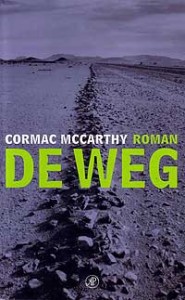
Just as All the Pretty Horses was a Western taken to extremes, The Road borrows from science fiction the struggle to survive after the apocalypse. It’s a plot as well known from movies (Mad Max) as from books (The Handmaid’s Tale); often it’s a way of rearranging society to question our own arrangements. But for McCarthy, it’s a way of taking life down to its bones. He strips away social bonds, yielding a bare stage on which to dramatize physical sensations (thirst and the slaking of thirst, cold and a fire, hunger and the taste of peaches) and elemental emotions. McCarthy is a sensual writer seeking extremes of sensation. He’s a theatrical, even bombastic writer, and he’s made a barren heath for King Lear to rave on. He favors adventure stories, and he’s written a millennial On The Road. He broods on fate, and he’s given man a reason to shake his fist against God.
The travelers in The Road are a nameless father and son, going south in hopes of living through the winter. The war that destroyed the world, or at least their part of it, the American South, has been going on for years; the boy, who is about eight, was born a few days after it began. We do not know how they have survived for so long, though we learn that the boy’s mother has committed suicide rather than live on. On foot, pushing a shopping cart, they follow a carless highway through forests and over burned stretches, sleeping in abandoned houses or under those handy overhanging rocks, watching out for the thieves and cannibals who are the only humans left.
They’re still alive, but to what purpose? The violence is so Biblical in scale (and in origin—McCarthy hints that the war was a sectarian one) that humans seem capable of nothing else. We see no restoration of social bonds, no little community banding together to have children, grow food, and regenerate the earth. The only groups the travelers meet are marauding companies of cannibals or, horrifyingly, prisoners about to be eaten. The only family they encounter commit a similar crime.
“We’re not survivors,” the mother says before she departs. “We’re the walking dead in a horror film.” Bodies lie everywhere, scorched or mummified, “shriveled and drawn like latterday bogfolk, their faces of boiled sheeting, the yellowed palings of their teeth.” The war, the man muses, took all social questions with it. “The frailty of everything revealed at last. Old and troubling issues resolved into nothingness and night.” The most sensible thing for the living to do, McCarthy suggests at various points, would be to die. The father considers the two bullets, then one bullet, left in his gun.
The man keeps going for his son’s sake, but he’s a selfish father, not a heroic one: he makes his son endure so that he himself will have an excuse for hope. McCarthy, who is 73, also has a small son; The Road is a Doomsday Book of paternal fears, but it may specifically be about an old man’s foreboding of death, his late, anxious joy in a young life, and his sorrow at his child’s going on alone.
Are we the good guys? the son keeps wanting to know. Yes, the father answers, but this is more reassurance than truth. The father rejects cannibalism, but to his son’s distress he refuses to risk their lives to save others. It is the son, not the father, who is still capable of horror at the dead or compassion for the living. The father has fed the son optimism, keeping none for himself.
Whatever you think of McCarthy’s view of human nature, The Road is a spectacular example of his storytelling skill. He is a remarkable stylist, a writer of long, rolling sentences; he’s often compared to Faulkner, Melville, Conrad or, in his more exaggerated moments, Thomas Pynchon. If you like realistic novels and straightforward prose, you can skip McCarthy and no one will hold it against you. (That said, the writing in The Road is relatively economical. Here at the end, even words seem in short supply.) But if you’re capable of suspending disbelief and going with him, he can draw you willingly into subjects you never thought you enjoyed: horses, whorehouses, knife fights in Mexican jails, the war of all against all.
Another writer McCarthy resembles, oddly enough, is Tolkien. Like Tolkien, he can evoke fictional worlds so intense, compelling, and fully imagined that you don’t read a book so much as enter it. (It’s probably for this urgency and sureness that McCarthy has such a devoted following, almost a cult status among his fans.) Like Tolkien, he takes us on quests, leaving the women behind. And the two writers share a terrific feel for the rhythm of a story. The Road speeds up (they encounter bandits and make a narrow escape), slows down (they plod along, food gone, starving), then flows suddenly into a calm, hidden pool (they find a stash of food and a place to rest, waking up to the startling normalcy of coffee, ham, and biscuits for breakfast). Often the moments of rest come in dreams or memories: a bleak depiction of what is will be followed by an idyllic glimpse of what was: brothers and sisters doing homework by a fire, or “the flash of trout deep in a pool…Reflecting back the sun deep in the darkness.”
The Road is a strangely beautiful book, despite or maybe because of its bleakness, which forces McCarthy to confess a love for the mundane: here pleasure is not in the mad trip across the wilderness but in the memory of home and warmth. We aren’t allowed to forget at what price warmth came. Coming to an antebellum mansion we’re told: “He held the boy’s hand and they crossed the porch. Chattel slaves had once trod those boards carrying food and drink on silver trays.” He is telling us how fragile goodness is, and, paradoxically, how much of it we still have to lose.
On the road, father and son meet an old man who calls himself Ely; he represents the prophet Elijah, who is forecast to return on Judgment Day. Ely tells the father, “Things will be better when everybody’s gone.”
Better for who?
Everybody….We’ll all breathe easier…When we’re all gone at last then there’ll be nobody here but death and his days will be numbered too. He’ll be out in the road there with nothing to do and nobody to do it to. He’ll say: Where did everybody go? And that’s how it will be. What’s wrong with that?
When the father suggests that his son might be a god, a young Prometheus carrying the fire of human life, the old man tells him it wouldn’t matter if he was: “Where men cant live gods fare no better. You’ll see.”
Yet McCarthy can’t bring himself to reach the end of the road in darkness. “Goodness” will save them, the man tells his son, his young Prometheus; it has before and it will again. We fear it’s another lie, to give his son hope; but at the same time it’s all the hope McCarthy has to give us.
Trouw, February 25, 2007. Cormac McCarthy, The Road (New York: Knopf, 2006); De Weg (Amsterdam: Arbeiderspers, 2007).